
 English | EN

The way we build software is changing faster than at any point in the last twenty years. Right now, most companies use AI as a smart helper that suggests lines of code — like autocomplete on steroids. But a much bigger shift is happening: Spec-Driven Development, where you write a clear description of what you want the software to do, and then AI agents build it for you — step by step, phase by phase, with humans approving at key checkpoints. This isn’t a future concept. Microsoft, AWS, and other major players already have working platforms built this way, and Gartner predicts AI agents will handle half of all enterprise software decisions by 2027.
The Agentic AI SDLC
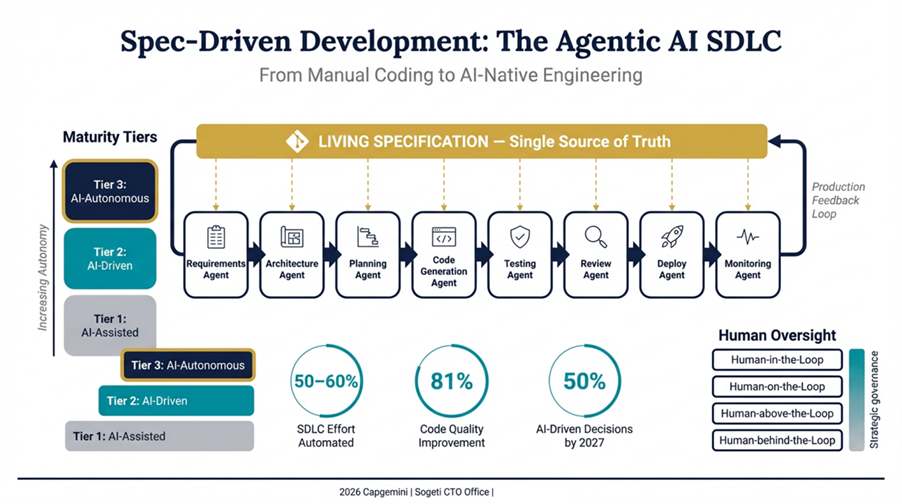
The first image shows the big picture: eight specialized AI agents, each handling one phase of software development — from gathering requirements all the way through to monitoring the live product. Think of it like an assembly line, but instead of factory workers, each station is an AI agent trained for that specific job. The key ingredient tying everything together is a living specification — a single document that tells every agent what to build and why. A feedback loop at the end sends real-world performance data back to update the spec, so the system keeps getting smarter. The framework also shows three levels of AI maturity (from basic code suggestions up to fully autonomous agents) and four models for how much human oversight you keep at each level. The results are real: companies using these approaches are seeing 81% improvement in code quality and automating over half their development effort.
But what is the “Living Specification”?
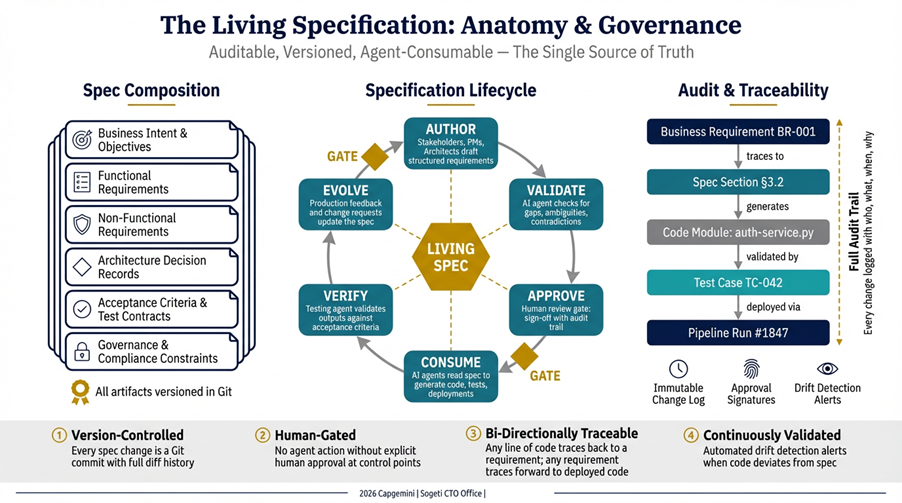
The second image zooms into the living specification itself — the document that makes the whole system work and keeps auditors happy. A living spec isn’t a dusty requirements document buried in SharePoint. It’s a structured, layered file that lives right next to your code in Git, containing everything from business goals to testing rules to compliance requirements.
It follows a six-step cycle: people write it, AI checks it for gaps, humans approve it, AI agents use it to build things, testing confirms everything works, and real-world feedback updates it — then the cycle repeats. Two mandatory human approval gates make sure no AI agent acts without sign-off. For audit and compliance teams, the critical piece is full traceability: you can follow any business requirement forward through the spec, into the code, through testing, and into the deployment pipeline — with every change logged, timestamped, and signed. It’s built to pass SOX, SOC 2, and IT governance reviews by design, not as an afterthought.
What IT Leaders Should Do Next
The window to get ahead of this shift is open right now, but it won’t stay open long. Companies that start today will build the skills, processes, and governance frameworks that become a lasting advantage. Those that wait will end up with messy AI tool sprawl, compliance headaches, and technical debt that’s much harder to clean up later. Here’s what we recommend: First, run a small pilot — pick a low-risk project, try the spec-driven approach, and learn what works before scaling. Second, start training your engineers to write great specs — in an AI-native world, the quality of the spec determines the quality of everything the AI produces. Third, bring your audit and compliance teams to the table now, not after you’ve already deployed — the living spec model is designed for them, but they need to help shape the rules from day one.
The bottom line: the IT leader’s role is shifting and Spec-Driven Development appears poised to move the needle to even more automation.