
 English | EN

Building AI has changed radically in the last 365 days. AI is now building AI. Models write a majority of their own code, create and curate training data, tune GPU kernels, and help select the best experiments to run. This is called RSI: Recursive Self-Improvement.
Here’s the big picture in four slides – and why it matters to every business leader.
Here’s the proof: at Anthropic, about 80% of production code is written by their own models — 18 months ago, it was roughly 1%. A third of top training data is now machine-created, and that mix trains models five to ten times faster. Google’s AlphaEvolve found a matrix-multiplication improvement that stood unrecognized for 56 years, and its chip-level upgrades return ~0.7% of Google’s worldwide computing power everyday.
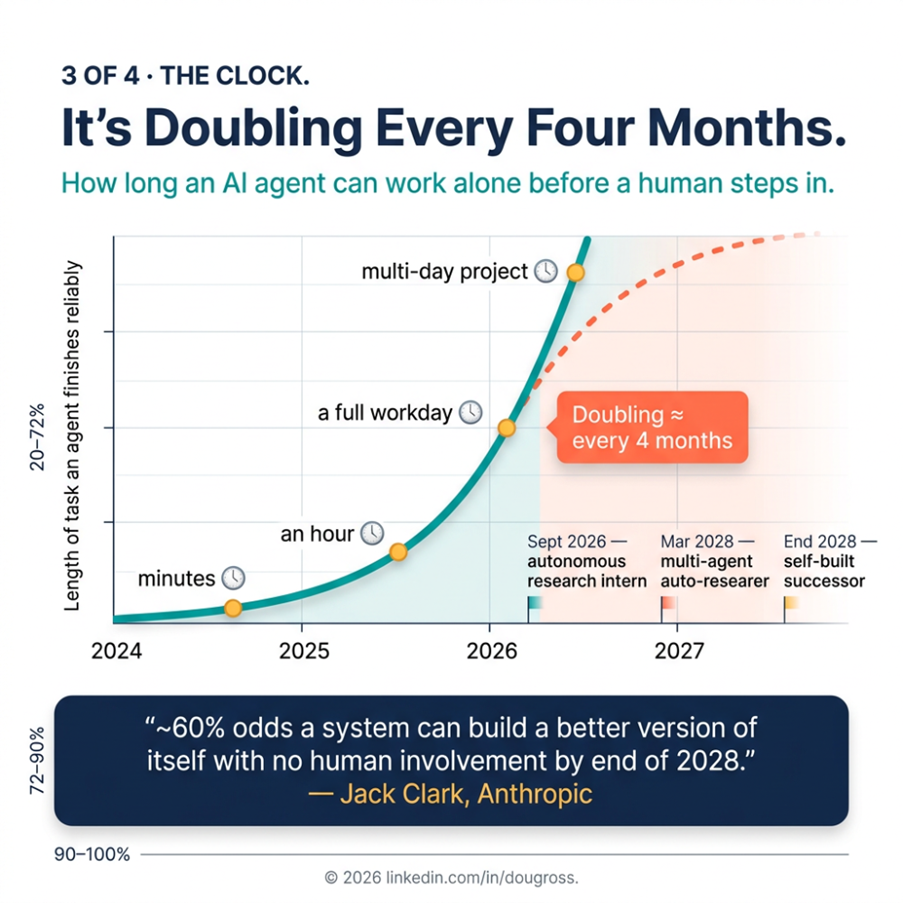
Here’s the number I’d email to my leadership team. The length of a task an AI agent can finish on its own — unsupervised, successful work — is doubling about every four months. Two years ago it was minutes. Now it’s a full workday. Extend that curve just a little and you get multi-day research projects without human oversight. That’s where we’re going – and labs are planning around it. Anthropic’s Jack Clark puts the odds at roughly 60% that by the end of 2028, you’ll be able to tell a system “build a better version of yourself” and it will just do it. Whether he’s right or off by two years, your three-year plan might have a new variable.
What does this do to my business? The honest answer is it depends on one thing — how cheaply you can prove an answer is right. Software is first, because you can run deterministic tests at scale. Chip design, financial modeling, actuarial science, and supply chain/logistics are right behind. Drug discovery and materials get a huge boost but have the regulatory side to deal with.
AI is now a major force driving the AI factory. It’s measurable today — 80% of the code, a third of the data, real records broken. And the trend line is steep: unsupervised work is doubling every four months, with credible leaders laying 60% Vegas odds on fully self-improving systems by year-end 2028.
When I asked Opus 5 which industries would be most impacted and in what order, the high-level picture looked like this.
Top 10 Industries Reshaped by Self-Improving AI (Opus 5)
Ranked by one thing: how fast you can prove the answer was right.
1. Software & IT — Code either runs or it doesn’t. Perfect, instant ground truth means this is where the loop closes first and hardest.
2. Semiconductors & Hardware Design — Simulation is the referee, so AI can iterate millions of designs overnight. Already discovering chip layouts and kernels humans missed. The only constraint is fab time (see Silicon ETF performance for example).
3. Cybersecurity — Attack and defense are scored games, which is exactly what self-improving systems consume. Assume both sides compound equally. Standing still means falling behind.
4. Financial Services — Trading, credit, fraud, and pricing all have brutal, instant feedback: you find out if you were right by the close or by the default. Models that retune themselves nightly become a baseline feature.
5. Insurance & Actuarial — The most underrated on this list. Insurance is a prediction wrapped in capital, so better predictions improve the product itself. Short-tail lines move now; long-tail lines wait years for claims to settle, and that wait is the whole constraint.
6. Life Sciences & Drug Discovery — Identification, molecule design, and trial planning collapse from years or decades to months. However, the lab and regulatory compliance set the pace.
7. Materials, Chemicals & Energy — Batteries, catalysts, alloys, grid optimization. AI searches the possibility space instead of guessing at it. Synthesis and physical scale-up are the bottleneck, not ideas.
8. Industrial & Engineering Design — Aerospace, auto, and heavy equipment already verify through simulation. Generative design flows straight into tooling. Certification cycles are the drag.
9. Professional Services — Legal, consulting, audit, and tax sell analysis, and analysis is now cheap to produce. The value migrates from doing the work to judging, signing, and standing behind it.
10. Healthcare Delivery — Enormous value in diagnostics, documentation, and care pathways, but trust, liability, and regulation set the clock. Slowest to change, hardest to change.
So start here, this quarter. Ask your CTO for one number: what percentage of your code and analysis is already AI-authored? Most executives are surprised by the answer. Then examine your ability to verify AI output like you do cybersecurity — because that’s the real ceiling on adoption.