
 English | EN
Why the Future Depends on Our Ability to Think Together
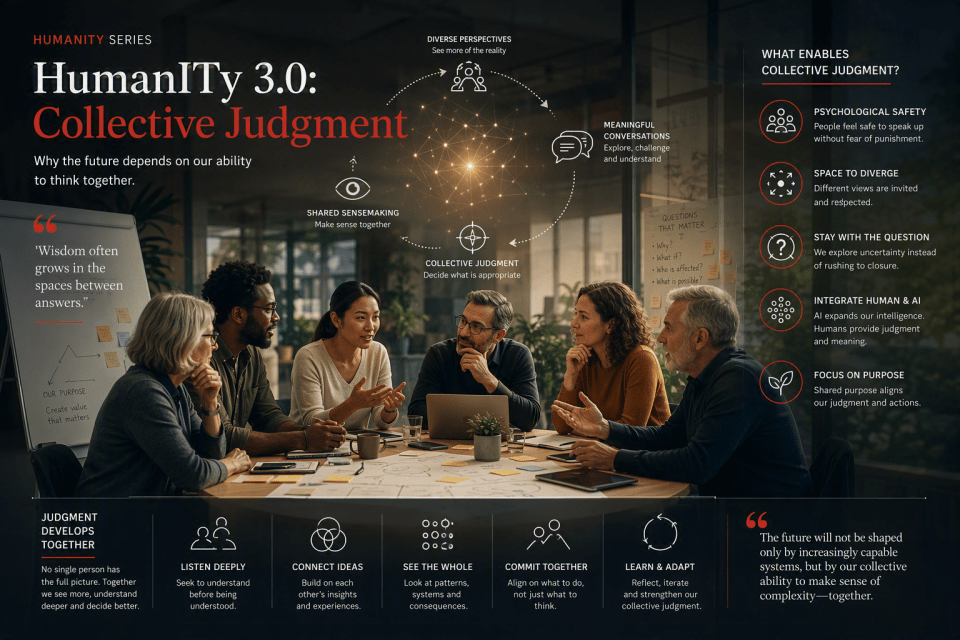
When no individual can fully understand the challenge, judgment must become a collective capability.
In the first article of this series, I explored the idea that judgment is a capability that must be practised. In the second, I argued that organizations significantly influence whether people feel able to exercise that capability.
Yet even if both conditions are met, one important question remains: what happens when the challenge facing us is too complex for any individual to fully understand?
Many of today’s most significant decisions share a common characteristic. No single person possesses enough knowledge to grasp the entire situation. Not the manager, the architect, the consultant, the AI system or even the leadership team. The challenge is simply too large, too dynamic and too interconnected.
In these situations, judgment becomes something different. It becomes a collective capability.
The End of the Expert Fantasy
For much of the industrial era, organizations were built around expertise. Knowledge, decision-making and authority were concentrated. This made sense when information moved slowly and specialization created clear advantages. The best strategy was often to identify the most knowledgeable individual and allow that person to decide.
Many organizations still operate according to this logic. When uncertainty increases, the instinctive response is to search for the expert: the person who knows, can provide the answer and can remove ambiguity.
But increasingly, that person does not exist. The complexity of modern systems has outgrown the individual. Digital ecosystems, AI-enabled organizations, global supply chains and rapidly evolving technologies create situations where no single perspective is sufficient.
The challenge is no longer finding the smartest individual. It is creating environments where different forms of knowledge can interact productively.
Intelligence Is Not the Same as Judgment
Organizations invest heavily in intelligence: business intelligence, artificial intelligence, predictive intelligence and collective intelligence. Intelligence is valuable, but intelligence and judgment are not the same thing.
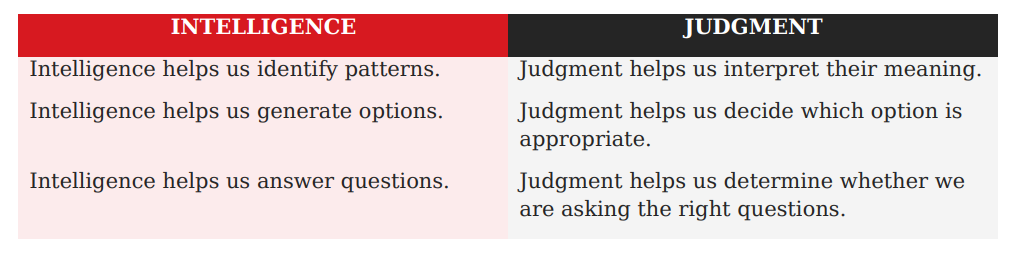
An organization can therefore become highly intelligent while still making poor decisions, especially if alternative perspectives never meet, uncertainty is hidden rather than explored, or disagreement is viewed as an obstacle instead of a source of learning.
Why Outliers Matter
Important signals rarely arrive in convenient forms. They often arrive as anomalies, unexpected events, difficult questions, awkward observations or people who think differently. What many systems experience as noise can contain useful information.
History is full of examples: customers who challenged assumptions, engineers who identified uncomfortable risks, employees who noticed problems before management did, and researchers whose findings initially appeared implausible.
Most organizations claim to value these perspectives. Many struggle to absorb them, not because people are unwilling, but because systems naturally seek stability. The familiar narrative often feels safer than the competing one.
Yet judgment develops when different perspectives encounter one another. It does not require everyone to agree. It requires disagreement to remain possible without becoming destructive.
The Spaces Between Answers
Several years ago, I became part of an informal conversation that gradually grew into something larger. People from different parts of an organization started sharing observations, questions and reflections. There was no formal agenda and no expectation of producing immediate decisions. The purpose was simply to understand.
Looking back, I believe something important happened there. People were not trying to win arguments. They were trying to make sense of situations together. Different interpretations could coexist, and disagreement did not necessarily end the conversation. It often deepened it.
Over time, those discussions became surprisingly valuable, not because they produced immediate answers, but because they created conditions where judgment could develop collectively.
That experience challenged a common assumption. Many organizations focus intensely on decisions. Far fewer invest in the conversations that make good decisions possible.
The AI Paradox
This challenge becomes even more important as AI is integrated into everyday work. Most discussions focus on faster analysis, better recommendations and improved automation. These capabilities matter, but they may create an unintended side effect.
As answers become easier to produce, organizations can begin losing the spaces where interpretation takes place. Discussion disappears because the answer arrives too quickly. Reflection disappears because efficiency becomes the dominant objective. Dialogue disappears because everyone moves on to the next task.
The paradox is that smarter systems may increase the importance of human conversation rather than reduce it. The more intelligence we have available, the more judgment matters. And judgment often develops through interaction rather than isolation.
HumanITy as a Collective Capability
At this level, HumanITy becomes less about the individual and less about organizational structures alone. It becomes a question of collective capability.
Can people think together without immediately needing consensus? Can organizations hold multiple interpretations at the same time? Can disagreement become a source of learning rather than conflict? Can technology strengthen these capabilities rather than weaken them?
These questions may ultimately determine whether intelligent systems enhance human potential or reduce it. Technology alone does not create wisdom. People do, usually together.
A Final Reflection
Many conversations about the future focus on increasingly capable systems: more automation, more intelligence and more autonomy. These developments are likely to continue. The important question is whether human capability evolves alongside them.
HumanITy 1.0 explored the individual’s ability to practise judgment. HumanITy 2.0 explored the organization’s ability to create space for judgment. HumanITy 3.0 asks a final question: can we develop judgment together?
The future will not be shaped solely by the quality of our technologies, nor solely by the capabilities of individuals. It will increasingly be shaped by something harder to measure: our collective ability to explore uncertainty, challenge assumptions and make sense of complexity together.
Perhaps that is where the next frontier of HumanITy begins.