
 English | EN
Imagine a large company running thousands of AI workloads across its cloud infrastructure. During the day, demand spikes, so more servers start running. At night, demand falls, but many resources continue to run because no one knows exactly when to switch them off or scale them down. Now imagine an AI agent continuously monitoring this environment. It understands the workload, monitors energy consumption, checks renewable energy availability, predicts future demand, and automatically decides where and when workloads should run. It might move a non-urgent task to a data center where renewable electricity is currently available, reduce unnecessary computing capacity during quiet periods, or postpone a flexible workload until a cleaner energy window. This is where Agentic AI could change the way we think about Green IT.
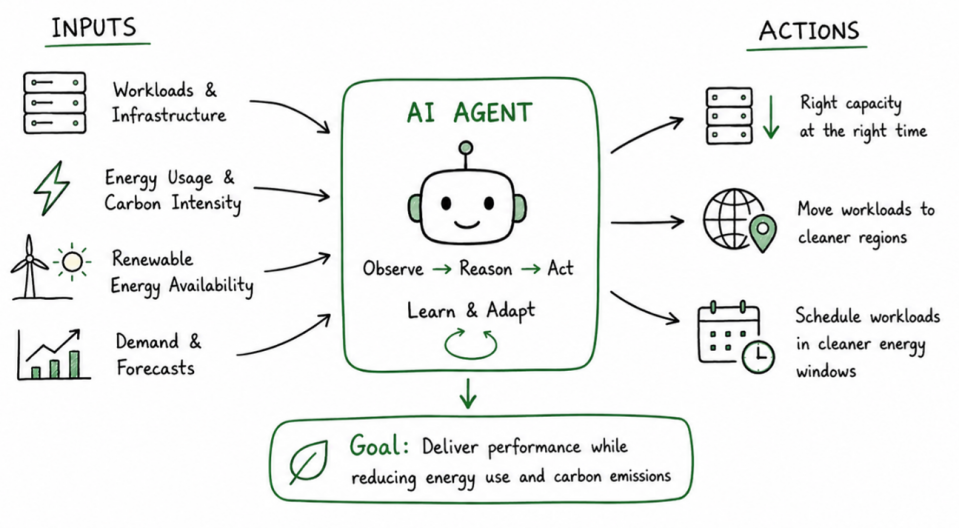
Today, Green IT often focuses on measuring energy consumption, improving hardware efficiency, using renewable energy, and optimizing data-center infrastructure. These approaches are important, but many decisions still rely on predefined rules or human intervention. Agentic AI offers another possibility: systems that can continuously observe, reason, act, and learn from their environment. Instead of simply reporting that a server consumed too much energy, an AI agent could investigate why and take appropriate action. It could monitor CPU, memory, and GPU utilization, network traffic, storage activity, workload priority, electricity prices, and even the carbon intensity of the electricity being used. The objective would be simple: to deliver the required computing service while using resources as efficiently and sustainably as possible.
The real opportunity becomes even more powerful when several specialized agents work together. One agent could forecast future computing demand. Another could monitor energy consumption across the infrastructure. A Carbon-Aware Agent could determine when and where electricity has lower carbon intensity. A Resource Optimization Agent could adjust computing capacity to match workload requirements. Another agent could monitor cooling efficiency in a data center. A central Coordinator Agent could synthesize these decisions and select the best action while respecting business requirements such as performance, availability, cost, and service-level agreements. In this model, Green IT becomes more than a monitoring activity. It becomes a continuous decision-making process in which digital infrastructure can dynamically adapt to reduce unnecessary energy and carbon emissions.
But there is an important paradox: Can an AI agent consume more energy than it saves? The answer could be yes if the system is poorly designed. Every prediction, reasoning step, and model call requires computing resources. A complex multi-agent system could therefore increase energy consumption. This means that Green Agentic AI itself must be designed with efficiency in mind. Agents should use the smallest suitable models, avoid unnecessary reasoning, reduce redundant computations, cache useful results, and measure the real impact of their decisions. Most importantly, their success should be measured not only by how intelligently they make decisions but also by whether those decisions actually reduce energy consumption or carbon emissions. In other words, the agent itself must also be green.
This leads us toward an exciting vision for the future of Green IT: autonomous, carbon-aware digital infrastructure. Instead of operating data centers and cloud environments with mostly static configurations, organizations could deploy intelligent agents that continuously balance performance, cost, availability, energy consumption, and carbon impact. AI workloads could become more flexible and environmentally aware. Computing could shift toward locations and time periods where cleaner energy is available. Cooling, storage, networking, and computing resources could be optimized dynamically rather than waiting for human intervention. The goal is not to stop using AI because it consumes energy. The goal is to make AI part of the solution to its own environmental challenge. If we can build AI agents that understand not only what needs to be done but also how much energy and carbon that decision may cost, Agentic AI could become one of the technologies helping us build a smarter and genuinely greener digital world.