
 English | EN
Why an agentic, end-to-end approach makes legacy renewal faster — and more predictable.
Many organisations run into the same constraint: their IT landscape slows innovation down. Legacy systems are complex, expensive to maintain and often poorly documented, so critical knowledge quietly leaves the organisation. At the same time the pressure to innovate faster, cut costs and raise quality keeps growing. Generative AI is changing that equation — provided it is applied deliberately rather than as a novelty.
A shift in how software is delivered
Generative AI changes the software delivery process itself, not just the coding step. It can read and interpret existing systems, generate the documentation that is missing, and surface dependencies, architecture and technical debt. Used across the full chain, it makes the work markedly more efficient — with higher quality and lower cost — because effort is spent where it matters instead of on manual discovery.
Modernisation, not a rebuild
Software modernisation is about renewing existing systems without rebuilding everything from scratch: migrating, refactoring, upgrading and documenting applications. The distinction matters, because a full rebuild is slow, costly and risky, while manual refactoring is labour-intensive and error-prone. Applying Generative AI end-to-end — always with governance and a human-in-the-loop — keeps quality and reliability intact while removing much of the manual effort:
- Existing code is analysed and interpreted automatically.
- Missing documentation is generated on the spot.
- Dependencies and architecture are made visible.
- Refactoring is targeted, rather than a wholesale rewrite.
The agentic model
This is the idea behind Sogeti’s Agentic Delivery Engine: an approach in which Generative AI is applied across the full software lifecycle — from analysis and design through to implementation and management. “Agentic” is the operative word. Rather than a single isolated tool, multiple AI agents each take on a task in the delivery chain and hand work off to one another; “engine” signals a repeatable, industrialised way of working instead of a one-off experiment. The aim is controlled acceleration — faster, but predictable and low-risk — with human validation and governance at every phase.
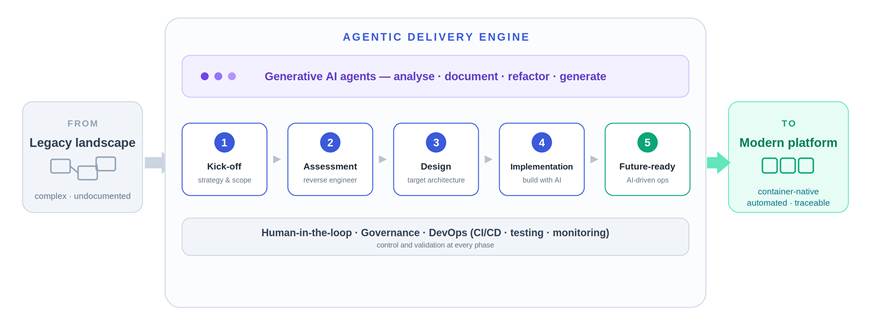
What it looks like in practice
In an analysis-driven migration of Java and Angular applications to a modern, container-native platform, automatic reverse engineering gave immediate insight into structure, dependencies and technical debt. That insight allowed targeted refactoring and modernisation rather than a complete rebuild. The result was a scalable, future-proof environment with fully automated deployments and end-to-end traceability from code to production.
The takeaway
The value of Generative AI in modernisation lies less in any single generated artefact and more in applying it consistently across the delivery chain, with people and governance in control. Approached that way, renewing a legacy landscape becomes not only feasible, but predictable — turning complexity into insight and action without starting over.