
 English | EN
On February 11, 2026, Coinbase unveiled Agentic Wallets — the first crypto wallet infrastructure purpose-built for AI agents — marking an economic milestone. Backed by the well-tested x402 protocol (already surpassing 50 million machine-to-machine transactions), major partnerships, and automated security guardrails, this launch comes at a pivotal moment. Gartner, predicts 40% of enterprise applications are expected to incorporate task-specific AI agents by 2026, up from less than 5% in 2025 (Gartner press release, August 26, 2025). In parallel, some estimates suggest that agentic commerce could grow significantly over the coming decade, potentially reaching multi-trillion-dollar scale by 2030.
What follows is a visual analysis of what Agentic Wallets are, how they work, and what they mean for individuals and organizations alike.
Agentic Wallets: Overview
Coinbase’s Agentic Wallets represent a shift in how AI agents interact with the global financial system — moving them from tools that recommend actions to participants that trade, manage liquidity, pay for resources, and earn yield without human intervention. Built on the x402 protocol — an open payments standard co-founded with Cloudflare that has already processed over 50 million transactions — the infrastructure provides plug-and-play financial skills, gasless trading on Base L2, and non-custodial wallets secured in Trusted Execution Environments. The ecosystem already spans major corporate adopters (Stripe, Cloudflare), blockchain networks (Base, Solana, Polygon), open-source tools (AgentKit, agent-wallet-skills), and a variety of new agent marketplaces.
Map of Real-World Implications
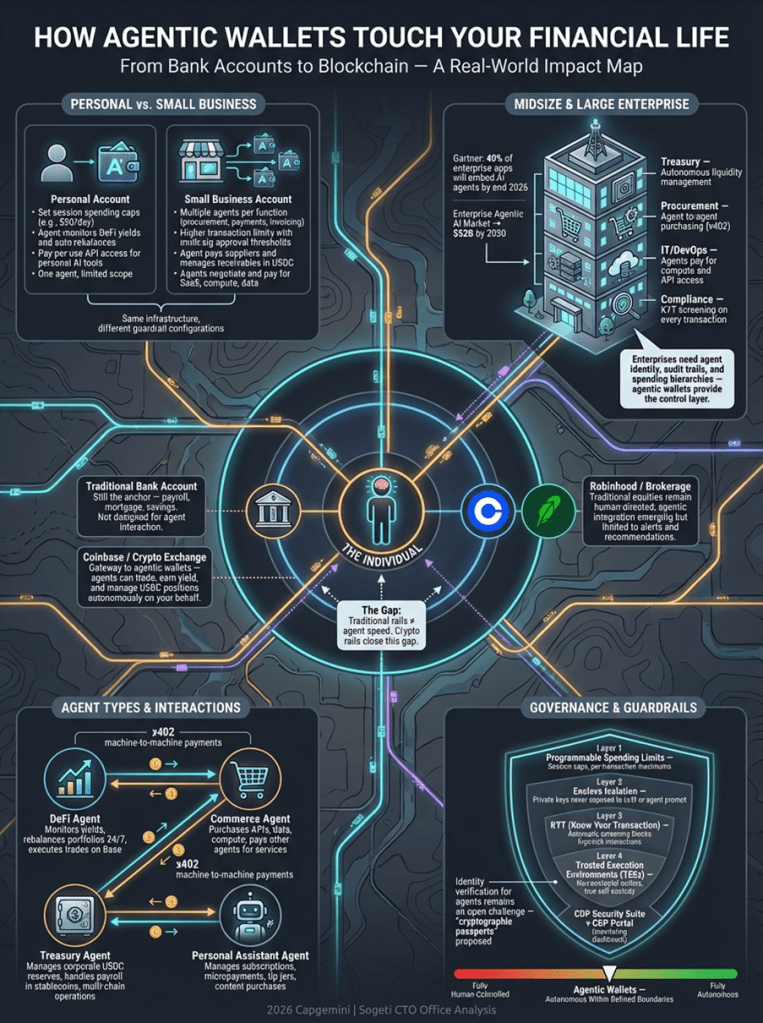
How Agentic Wallets Touch All of Us
For anyone with a bank account, a Coinbase wallet, or a Robinhood portfolio, the emergence of agentic wallets is a true milestone. Traditional banking processes — built decades ago and using manual approvals — cannot support software that needs to transact and clear in milliseconds, 24 hours a day. Agentic Wallets bridge this gap by enabling users to deploy a single agent that auto-rebalances accounts and manages daily spending caps; small businesses can run multiple agents across procurement, invoicing, and supplier payments — all on the same underlying infrastructure with different guardrail configurations. For larger enterprises, the implications are structural: autonomous treasury management, agent-to-agent procurement, compute and API self-provisioning, and built-in compliance screening on every transaction. The governance framework — layered from programmable spending limits and enclave-isolated private keys to KYT (Know Your Transaction) screening and Trusted Execution Environments — ensures that autonomy operates within clearly defined boundaries, not without them.
Agentic Wallets mark a turning point in the evolution of the global financial system: non-human participants. With point-of-sale systems integrating x402 for machine payments, the establishment of the x402 Foundation, and 13,000 AI agents registering on Ethereum in a day, the infrastructure for an autonomous machine economy is materializing right now. For organizations, the critical challenge is understanding how quickly they can establish the governance frameworks, guardrail configurations, and institutional readiness to participate in a financial landscape where the most active transactors may not be human at all.