
 English | EN
The rise of AI-assisted software development has somewhat stalled at the level of individual code completion. Most have seen real productivity gains, but not a paradigm shift. What we’re seeing is that unlocking breakthrough value is not in smarter autocomplete but in agentic orchestration: frameworks that deploy specialized AI agents across the full SDLC with the rigor, traceability, and repeatability that an enterprise requires. Two open-source frameworks — BMAD (Breakthrough Method for Agile AI-Driven Development) and TEA (Tool-Environment-Agent Protocol) — represent a far different approach: AI is not used as a tool but as an organized team of experts operating as a governed and structured team.
Together, they offer enterprise technology leaders a promising and extensible architecture for industrializing AI-driven delivery at scale. The following graphics offer an executive-level overview of this new dynamic.
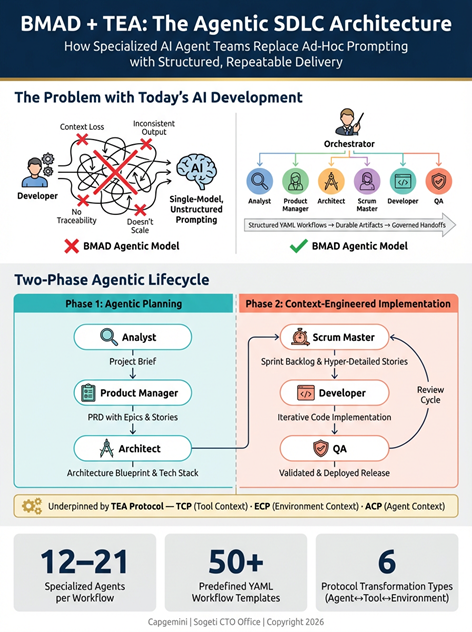
BMAD+TEA Overview
BMAD fundamentally restructures AI-assisted development by replacing the somewhat fragile pattern of a single developer prompting a single model with a governed team of 12–21 specialized AI agents, each with defined expertise, explicit deliverables, and structured handoffs. The framework’s two-phase approach — rigorous agentic planning followed by context-engineered implementation — mirrors the discipline of best-in-class engagements: comprehensive specs are produced before a single line of code is written, dramatically reducing rework and misalignment. When underpinned by TEA’s protocol layer (TCP, ECP, ACP), this architecture gains dynamic tool orchestration, persistent environment state, and hierarchical agent coordination — transforming what was previously bespoke AI prompting into an industrialized, auditable, and repeatable delivery pipeline suitable for enterprise-grade software portfolios.
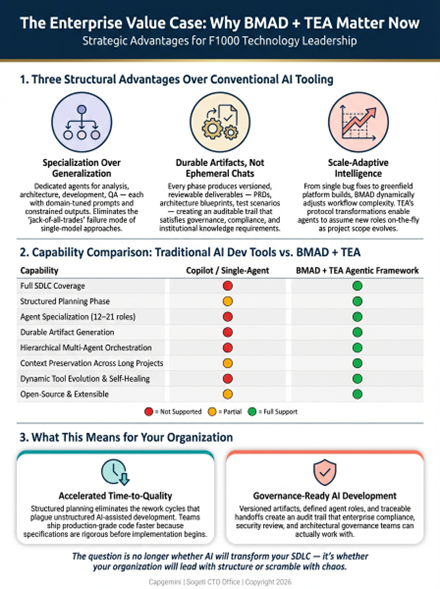
The Competitive Advantage?
For tech leaders reviewing their AI development strategy, the key distinction is between tools that assist individual developers and frameworks that transform organizational delivery capability. BMAD and TEA together address three structural weaknesses of conventional AI coding assistants:
- Lack of specialization (solved by dedicated agent roles)
- Ephemeral outputs (solved by durable, versioned artifacts)
- Inability to scale beyond single-task interactions (solved by hierarchical orchestration and protocol transformations)
The implications are pretty profound — accelerated time-to-quality through front-loaded planning, and governance-ready development processes that produce auditable trails needed for enterprise.
My belief is that organizations that adopt structured agentic frameworks will compound their advantage over those still relying on ad-hoc, single-model prompting.