
 English | EN

Abstract
The automotive industry is undergoing a profound transformation, characterized by advancements in autonomous driving, connected vehicles, and sophisticated in-car systems. As vehicles increasingly rely on communication and data, the need for robust cybersecurity measures has become evident. Post-Quantum Cryptography (encryption safe from quantum computers) is essential to secure the vehicles of the future, and its implementation needs to start now. Quantum computers possess the capability to break traditional cryptographic algorithms, posing a substantial risk to automotive systems. Every component within a vehicle, from small controllers to electric motors and GPS systems, is susceptible to data interception, decryption, and manipulation. This threat goes beyond conventional safety concerns, necessitating a comprehensive approach to cybersecurity that incorporates Post-Quantum Cryptography and provides the agility to handle future threats. This proactive approach will not only protect sensitive data but also enhance overall vehicle safety, paving the way for a secure and resilient future for the automotive industry.
1. Rise of Quantum Computing
While quantum computers were once a theoretical concept that fascinated scientists, they are now increasingly becoming a reality for practical applications with the potential to revolutionize industries. This also applies to the automotive industry, as quantum computing is already being actively explored in areas like aerodynamic simulations, battery chemistry and logistics optimization.1 These developments showcase that quantum computing is not just a distant future but already shaping automotive innovation.
Unlike classical computers, which operate on binary bits (0 or 1), quantum computers use qubits that leverage quantum mechanical properties such as superposition. This allows quantum computers to evaluate multiple outcomes simultaneously. Exceeding the capabilities of classical systems and potentially solving problems exponentially faster. However, it is important to understand that quantum computers are not an incremental improvement in computing hardware. Quantum computers represent a fundamental shift in how we compute. While classical computers remain highly efficient and superior for most tasks, quantum computers are expected to outperform them in specific domains like optimization or chemical simulations. [1]
Currently one of the biggest challenges lies in building stable, error-corrected qubits at scale, as current systems exhibit significant noise and require complex error correction. However, the race to build scalable hardware is on, with many startups competing and multiple major tech companies, like IBM, Google, and Microsoft investing heavily. 2 Governments from all major economies, like the USA, China, Japan and the EU, are heavily funding quantum research, as quantum computers and their capabilities are crucial to achieving technological leadership and national security [2] 3 4.
The Quantum Risk: Q-Day
Once quantum computers are developed at sufficient scale and with stable qubits, they will be able to easily break widely used cryptographic algorithms like Rivest–Shamir–Adleman (RSA) and Elliptic Curve Cryptography (ECC). This moment is referred to as Q-Day: The day when quantum computers can decrypt data previously considered secure. 5 While Q-Day has not yet arrived, the risk is real and growing with severe implications and governments, businesses and cybersecurity experts are taking it seriously. 6
The impact of Q-Day is profound, as sensitive data from financial data to state secrets could be exposed. Public media, including outlets like Forbes, have begun to highlight the urgency with headlines like: Why You Should All Be Worried About Q-Day And The Collapse Of Digital Security [5]. However, not all data is equally vulnerable, and not all systems require immediate migration. To properly assess the quantum risk, we need to better understand the threat, starting with the timeline of Q-Day and the concept of harvest now, decrypt later attacks.
Timeline of Q-Day for Automotive
The development of quantum computers is non-linear, like artificial intelligence, it may accelerate suddenly due to breakthroughs in quantum error correction, qubit scaling or algorithm developments [6]. Early estimates placed Q-Day around 2035, but recent projections suggest it could arrive as early as 2030. 7
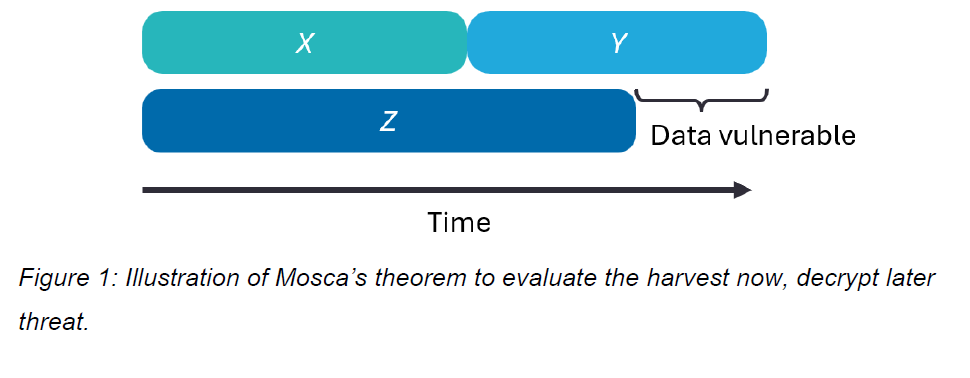
Although quantum computers cannot yet break encryption, adversaries can already steal and capture encrypted data today and decrypt it in the future. This is known as a harvest now, decrypt later attack. Data with long-term value, such as medical records, financial transactions, or proprietary engineering designs is particularly vulnerable. It can be stolen now and decrypted once the quantum computers mature. To evaluate the risk of an attack to one’s data, we can use Mosca’s theorem, which states [6]:
If the amount of time that data must remain secure (X) plus the time it takes to upgrade cryptographic systems to become quantum-safe (Y) is greater than when large-scale quantum computers will be available with enough power to break cryptography (Z), your data is vulnerable.
Mosca’s theorem: If X + Y > Z, then worry.
2. Why is Automotive at Risk?
The automotive industry is increasingly recognized as a high-value target for cyberattacks, as it combines several attractive features for potential adversaries8:
- A large amount of consumer data: Vehicles collect and transmit sensitive information such as location, driving behavior, biometric identifiers and infotainment usage.
- Complex and globally distributed supply chains: Thousands of Tier-1 and Tier-2 suppliers contribute to vehicle production, often with varying cybersecurity maturity.
- High-capital infrastructure with strategic value: As vehicles evolve into connected fleets and public infrastructure, they become potential targets for criminal organizations and state actors in geopolitical conflicts.
These characteristics make the automotive industry vulnerable across the whole ecosystem, from suppliers to original equipment manufacturers (OEMs). OEMs and their suppliers are already under attack [8], and the threat is growing due to the digital transformation of the automotive industry.
Modern vehicles are no longer isolated purely mechanical systems. They are software-defined platforms, with critical functions such as steering, ignition, braking, and Advanced Driver
Assistance Systems (ADAS) controlled by software. Thus, drastically increasing their attack surface and the potential consequences of security incidents [8].
We can roughly categorize the threat landscape into four domains:
- OEMs and Supply Chain
- Vulnerabilities in Tier-1 and Tier-2 suppliers
- Inconsistent security standards across partners
- Legacy systems and slow update cycles
- Vehicle Infrastructure
- In-vehicle networks (CAN, Ethernet)
- Electronic Control Units (ECUs) and embedded systems
- Infotainment and telematics units
- External Communication Interfaces
- Vehicle-to-X (V2X) protocols
- Charging stations and smart grid interfaces
- Cloud-based fleet management systems;
- Backend Infrastructure & Services
- Server compromise and privacy data breach
- Personal identity exposure, financial data breach
- Location privacy violation, behavioral profiling
Quantum computers provide here a new attack angle, as they are threatening commonly used encryption methods. This might seem like a distant future, however, considering Mosca’s theorem and the long lifecycle of vehicles, the threat is real. Vehicles developed today will remain on the road for 15-20 years, and cryptographic systems embedded in them must remain secure throughout that time [9].
Fortunately, solutions are already available to help create a quantum secure future and the next chapter will explore these technologies.
3. Cryptographic Standards and Options in a Post Quantum World
The emergence of quantum computers is creating two distinct challenges for modern cryptography9:
Symmetric Encryption: In symmetric encryption both the encryption of the plain text and the cypher text use the same key. Quantum computers have been theorized to be up to twice as fast at searching for these keys by employing Grover’s algorithm. This threat can be mitigated in the simplest way by doubling the key lengths, i.e. switching from Advanced Encryption Standard (AES)-128 to AES-256 to maintain the same security [9].
Asymmetric Encryption: In asymmetric encryption two different keys, a private and a public key, are employed. Algorithms based on RSA and ECC are vulnerable to quantum attacks employing Shor’s algorithm. As it enables quantum computers to solve integer factorization significantly faster, recovering private keys in polynomial time, and thus rendering RSA, ECC and related protocols vulnerable in a post-quantum world [9].
Post Quantum Cryptography (PQC)
Recognizing the quantum threat, the National Institute of Standards and Technology (NIST) in the USA initiated the PQC Standardization Process in 2016 to identify quantum-resistant algorithms. After several rounds of evaluation, NIST announced four finalists for standardization10:
- CRYSTALS-Kyber (ML-KEM) –Key encapsulation mechanism
- CRYSTALS-Dilithium (ML-DSA) –Digital signature algorithm
- SPHINCS+ (SLH-DSA) –Hash-based signature scheme
- FALCON (FN-DSA) –Compact lattice-based signature scheme
These algorithms are designed to replace vulnerable algorithms, offering strong security against quantum attacks while remaining efficient for real-world deployment. They are based on hard mathematical problems, such as multidimensional lattice structures, which are believed to be resistant to future quantum attacks.
Quantum Key distribution (QKD)
An alternative approach to quantum-safe communication is Quantum Key Distribution (QKD). Unlike PQC, which relies on mathematical difficulty, QKD uses quantum mechanics to securely distribute encryption keys. QKD is considered to be unbreakable, as any attempt to intercept the key alters the quantum states, thus revealing the interception attempt.
However, QKD requires specialized hardware to accomplish this task, which often makes it difficult to implement in practice. In addition, current approaches involving photons are often limited by requiring a direct line of sight between the communicating parties, making it impractical for vehicles.
Despite ongoing research into QKD for infrastructure-to-vehicle (I2V) and vehicle-to-vehicle (V2V) communication, its maturity level remains experimental and not suitable for current implementation11.
Comparative Overview
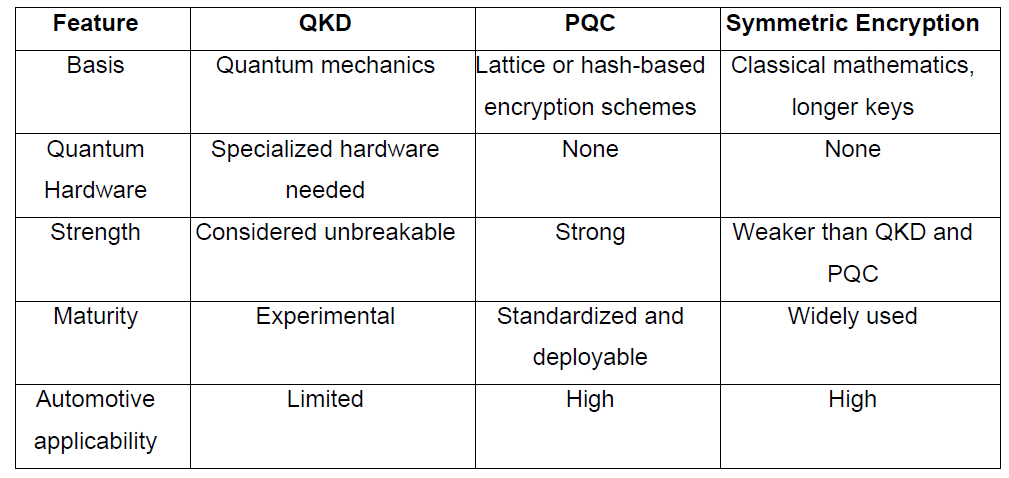
The quantum threat is real, but so are the solutions. PQC provides a practical and secure way to future-proof vehicles. While symmetric encryption can be strengthened in the short term by extending key lengths, asymmetric encryption remains at risk. QKD may offer long-term potential, but PQC is the clear choice for scalable, deployable quantum-safe security, however, the next challenge is implementation.
4. Implementation Challenges
The process of determining a set of quantum safe algorithms is a major milestone, however, it marks only the beginning of the transition towards a quantum-secure automotive ecosystem. The next step is the implementation of the algorithms in actual operating environments [6].
The automotive industry faces unique challenges, as it relies on embedded systems, legacy infrastructure and operates in a highly regulated environment. Several studies have explored the feasibility of integrating PQC into automotive platforms, including internal vehicle networks, OEM-specific protocols and V2X systems, a detailed literature review can be found in Ref. [9]. Here, we want to highlight several key challenges:
Performance Constraints
Automotive Electronic Control Units (ECUs) perform a wide range of tasks, from infotainment to safety critical operations like braking and steering. These systems are resource-constrained and often operate under real-time requirements.
PQC algorithms, particularly lattice-based schemes, introduce larger key sizes and longer signature times compared to legacy algorithms. Thus, before migrating to PQC algorithms one needs to carefully evaluate if the selected PQC algorithms can deliver similar performance on the employed hardware platform.
For example, Bos et al 12 implemented lattice based Dilithium signature verification algorithm for secure boot on an automotive-grade processor (S32G274A). While the authors deemed it feasible and practical to transition to a post-quantum secure boot, the performance of the Dilithium signature verification is indeed worse than ECC/RSA verification [12].
With verification of signatures being 5-10 times slower than that of classical asymmetric cryptography, Time-sensitive operations require careful evaluation and potential optimization of the employed PQC algorithms [9].
Many cryptographic operations are embedded in time-critical functions, including safety-relevant ECUs. For example, airbag deployment systems require response times between 10 and 50 milliseconds, anti-lock braking systems must adjust brake pressure within 5 to 20 milliseconds, and autonomous emergency braking systems need to initiate collision avoidance maneuvers in under 200 milliseconds. These constraints place strict performance requirements on the cryptographic algorithms used, and any migration to PQC must ensure that system responsiveness is not compromised. However, these performance constraints can often be mitigated by choosing the right hardware, i.e. opting for an increased amount of memory compared to classical systems.
Hardware Limitations and Over-the-Air (OTA) Constraints
Hardware not only affects performance, but it also limits upgradability. Automotive systems rely heavily on Hardware Security Modules (HSMs) and Trusted Platform Modules (TPMs) to perform cryptographic operations in isolated, secure environments. These modules are essential for secure boot, key storage, and cryptographic execution [9]. However, the isolation that makes HSMs secure also presents a significant challenge for PQC adoption:
- Several current HSMs/TPMs do not support PQC algorithms, which require different computational models and larger key sizes.
- Retrofitting or replacing HSMs across vehicle platforms is costly and logistically complex, especially given the long lifecycle of vehicles and the diversity of hardware architectures.
- Many ECUs rely on hardcoded symmetric keys stored within HSMs, which are difficult to update post-deployment.
These hardware limitations also hinder Over-the-Air (OTA) updates, which are commonly used to patch software vulnerabilities. Without PQC-ready hardware, cryptographic updates may be impossible, leaving vehicles vulnerable for years. Future vehicles must be designed with PQC compatibility in mind from the beginning as retrofitting cryptographic hardware is often costly or unfeasible, making early planning essential.
Supplier Network Complexity
Implementation of PQC in the automotive sector is not confined to OEMs, it must be pursued by the entire global supplier network. Thus, coordination between different hardware, software and security regulations makes a coordinated PQC transition extremely challenging. The complexity of this task is well illustrated by a statement from the Capgemini Research Institute’s report [6]:
“We depend on thousands of suppliers, and not all can afford to invest in post-quantum security. For strategic ones, we must share responsibility and help them reach a good security level.”
– Julio Padilha, from Volkswagen & Audi South America
This quote highlights the need for shared responsibility and a collaborative planning approach. OEMs must take the lead and support strategic suppliers in their PQC transition, provide guidance and enforce minimum standards across the supply chain. The industry must act now to define these standards before regulators do.
5. Regulations are coming
The need to transition to post quantum security is not just driven by the desire for higher safety for consumers, it is increasingly becoming a regulatory need for industry as governments aim to secure key infrastructure, including the automotive sector for the quantum era.
Global PQC Regulatory Momentum
In the US the NIST has set a guideline for phasing out legacy algorithms. By 2030, algorithms such as RSA, ECDSA, and ECDH will be phased out in federal systems, with full disallowance by 2035. While mandates for contractors are still evolving, the direction is clear: early adoption is expected. 13
In the EU, the European workstream for PQC has recently released a coordinated implementation roadmap for PQC. Member states are expected to: 14
- By 2026: Establish national PQC strategies and roadmaps.
- By 2030: PQC transition for high-risk systems completed.
- By 2035: Complete the transition across all feasible systems.
These efforts are supported across Europe by publicly funded initiatives, such as PQ-REACT or Q-PrEP, which aim to prepare stakeholders for the PQC transition 15 16.
Automotive-Specific Standards and Gaps
European regulations such as the EU Cyber Resilience Act mandate cybersecurity maintenance throughout a vehicle’s lifecycle. These regulations compel manufacturers to implement robust cybersecurity measures to protect against emerging threats. Non-compliance can result in significant penalties, including denial of vehicle type approval in UNECE member countries.
The automotive industry is governed by several cybersecurity standards:
- ISO/SAE 21434: Cybersecurity engineering for road vehicles
- UNECE R155 (CSMS): Cyber Security and Cyber Security Management System
- UNECE R156 (SUMS): Software Update and Software Update Management System
- SAE J3061: Cybersecurity guidebook for cyber-physical vehicle systems
- ISO 24089: Software update engineering
While these standards provide a strong foundation, they currently lack explicit support for PQC. Limitations include:
- Constraints on packet sizes and certificate formats
- Incompatibility with larger PQC key and signature sizes
- Slow revision cycles typical of automotive standardization
Moreover, while PQC integration is feasible, performance and compatibility vary widely across platforms. Some non-NIST algorithms may offer better performance for in-vehicle applications, but standardization is still ongoing [9]. NIST’s PQC standardization took over 8 years. Automotive standards often require 5-10 years for full revision and adoption, however, waiting is not an option. The threat is real, the algorithms are here, we need to move forward.
6. Cryptoagility and Recommendations for Automotive
When preparing for the transition to post-quantum cryptography, one of the key concepts is cryptoagility. The idea is to not just focus on a one-time replacement of algorithms, it is about building systems that are flexible, adaptive and resilient against future quantum and non-quantum threats. It is a general approach to cybersecurity that goes beyond quantum safety and focuses on enabling organizations to respond quickly and effectively to new vulnerabilities, emerging technologies and evolving regulations.
Recommendations
There are several extensive roadmaps and recommendations, as published by NIST [13] or the Capgemini Research Institute [6]. Here, we would like to highlight several that we consider key for the automotive industry:
- Education of Stakeholders: Awareness across OEMs and suppliers is critical, everyone involved in vehicle development must understand the implications of PQC and advantages of cryptoagility.
- Adopting Cryptoagility: This includes evaluating cryptographic dependencies, automating key and certificate management, and designing systems that can evolve over time and react quickly to the changing threat landscape.
- Putting PQC into Perspective: PQC does not address a distant threat. It is a regulatory and operational issue that affects the entire vehicle lifecycle and should be evaluated across all vehicle domains from ECUs to V2X communication and considered in the broader threat landscape.
- Conducting PQC Pilots: Running pilots is essential to test integration, performance and compatibility of PQC algorithms in real automotive environments to identify practical challenges.
- Implementing Hybrid Cryptography: Hybrid approaches that combine cryptography with PQC algorithms should be adopted now, ensuring resilience against current and future threats, allowing smooth transitions as standards evolve.
- Shape Standards and Regulations: The automotive industry must take an active role in shaping PQC standards and regulatory frameworks. We need to be proactive and identify the best practices now to ensure they are practical, scalable and aligned with real-world needs.
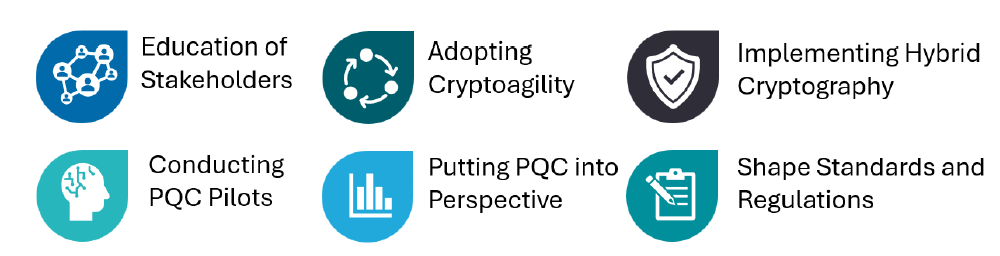
Figure 2: Overview of recommendations for the PQC transition in the automotive industry.
7. Conclusion
Cybersecurity in the automotive sector is undergoing a profound transformation, driven by the rise of software-defined vehicles and the rapid progress of quantum computing. Just as crash tests and seatbelts have once shaped consumer trust, buyers are increasingly influenced by software reliability and cybersecurity. Post-quantum cryptography offers a promising path forward, but its adoption must be strategic, collaborative, and agile. Cryptoagility is key for this transition enabling systems to evolve, adapt, and remain secure in the face of unknown future threats.
A robust, quantum-resilient cybersecurity strategy will not only protect data, but it will also define brand reputation, regulatory compliance, and long-term customer satisfaction. The time to act is now. By embracing cryptoagility, supporting suppliers, and preparing for PQC integration, the automotive industry can build a secure and resilient future, one where innovation and safety go hand in hand.