 English | EN
1. Hypervelocity Engineering: Why Your Delivery Speed Is Determined by the Slowest Pirate
For years, software organizations have been obsessed with accelerating development. Agile replaced waterfall. DevOps replaced handovers. CI/CD replaced manual release processes. AI-assisted development is now beginning to replace parts of coding itself.
The result is remarkable.
Teams that once needed months to deliver functionality can now create meaningful increments in hours. AI copilots generate code, tests, documentation, and deployment scripts. Autonomous agents help developers navigate complex codebases. Entire engineering organizations are discovering they can move faster than they ever thought possible.
Yet many leaders are puzzled. Despite all this progress, their overall delivery speed has barely changed. The reason is surprisingly simple. A delivery chain does not move at the speed of its fastest link. It moves at the speed of its slowest one. In the age of Hypervelocity Engineering, this may be the most important lesson organizations need to relearn.
2. The Illusion of Engineering Speed
Most transformation initiatives focus on improving individual functions.
Developers become more productive. Testers automate more effectively. Operations teams modernize infrastructure. Architecture teams streamline governance. Each function proudly reports impressive gains. The developers celebrate a 50% productivity increase. The testing team cuts execution time in half. The platform group introduces automated provisioning.
Yet somehow the customer sees very little difference.
Why?
Because customers experience end-to-end delivery, not local optimization. If one step in the value stream remains slow, every improvement elsewhere eventually runs into that constraint. It is like assembling the fastest ship with most determined crew only to discover that every voyage still depends on a harbor official stamping departure papers by hand.
The Tale of the Approval Pirate
A few years ago, I worked with a client that perfectly demonstrated this phenomenon.
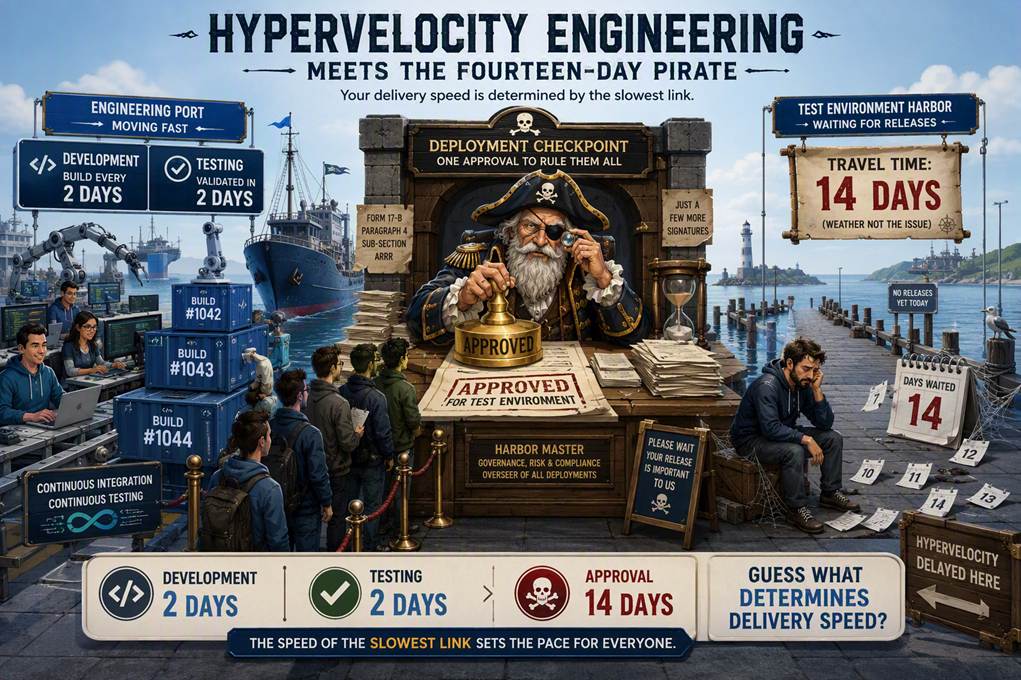
The developers had become genuinely agile. They could produce a testable build roughly every other day.
The testers were equally impressive. Their automation, risk-based testing approach, and streamlined processes meant most builds could be validated within one or two days.
On paper, this should have enabled a highly responsive engineering organization.
Yet new functionality still took weeks to progress.
The culprit was not development. It was not testing. It was not infrastructure. It was deployment.
Moving anything into the dedicated test environment required a special approval process. This approval could only be granted by a particularly senior and highly respected pirate somewhere high in the organizational hierarchy. I never fully understood the logic behind the process. Nobody seemed to. What mattered was that every deployment request entered a queue and remained there for approximately fourteen days while awaiting the sacred seal of approval.
Think about that for a moment.
Development: two days.
Testing: two days.
Deployment approval: fourteen days.
The organization spent enormous effort optimizing activities responsible for a small fraction of the overall timeline while largely accepting the biggest delay as an unavoidable law of nature.
The result was predictable. The fourteen-day pirate won. Every time.
3. Hypervelocity Changes the Economics
Historically, many of these inefficiencies were tolerable.
When development itself required weeks or months, a few additional approvals barely moved the needle.
Hypervelocity changes that equation completely.
As AI-assisted development accelerates engineering activities, bottlenecks become dramatically more visible.
When code generation becomes ten times faster, governance suddenly looks slower.
When testing becomes automated, deployment approvals suddenly look slower.
When autonomous delivery pipelines can execute in minutes, manual handoffs begin to resemble archaeological artifacts.
The challenge is not that governance, security, architecture, or quality are unnecessary.
Quite the opposite.
The challenge is that practices designed for a slower world often become friction when applied unchanged to a faster one.
Organizations discover they are operating a modern racing yacht using procedures originally designed for a wooden merchant vessel crossing the Atlantic.
The intentions remain noble.
The results become counterproductive.
4. The Shift from Speed to Flow
This is why Hypervelocity Engineering is not fundamentally about coding faster.
It is about improving flow.
Many organizations still focus on local productivity metrics:
- Story points completed
- Code generated
- Tests automated
- Tickets closed
- Defects resolved
These measures are useful, but they can create a dangerous illusion.
Hypervelocity is achieved not when individual teams become faster.
Hypervelocity is achieved when value moves through the entire system faster.
A developer waiting fourteen days for approval is not operating in a hypervelocity environment.
Neither is a tester waiting for infrastructure.
Nor is a release manager waiting for governance committees.
The true objective is continuous flow from idea to customer outcome.
That means identifying constraints wherever they exist, regardless of organizational boundaries.
5. The New Engineering Question
For years, engineering leaders asked: “How can we make development faster?”
Today, a better question is emerging:
“What is preventing value from flowing?” The answer may not be where you expect. It may be an approval process. It may be a compliance review. It may be availability of test environments. It may be data provisioning. It may be architecture governance. It may be change management.
Or perhaps, somewhere deep within the organization, a very important pirate is still carefully guarding a release stamp that nobody has dared question for years.
Hypervelocity Engineering forces organizations to confront these realities. Because once developers can generate solutions in hours, every organizational inefficiency becomes impossible to hide.
6. Beyond Development Velocity
The companies succeeding in the next generation of engineering understand something fundamental. Development velocity is only one component of delivery velocity. Testing velocity matters. Deployment velocity matters. Governance velocity matters. Decision velocity matters. Learning velocity matters. Every step of the value stream contributes to the overall outcome. The goal is therefore not to create the fastest developers. The goal is to create the fastest learning system. One where ideas move rapidly from concept to customer. One where feedback returns just as quickly. One where quality, security, operations, governance, and engineering move as a coordinated fleet rather than isolated ships.
Because a modern engineering organization is not limited by its most talented team. It is limited by its largest constraint. And in the age of Hypervelocity Engineering, the most dangerous bottleneck is often the one nobody thinks to question. So by all means invest in AI-assisted development. Automate testing. Modernize your platforms. Empower your engineers. But before celebrating how quickly the crew can hoist the sails, take a careful look around the deck.
Somewhere, there may still be a pirate guarding a fourteen-day approval stamp.
And that pirate is determining your delivery speed.