
 English | EN
In the evolving history of software development, a quiet revolution is unfolding, one that blends artificial intelligence with environmental responsibility. As computing power drives innovation, it also drives energy demand. The digital world’s carbon footprint now rivals that of major industries, prompting researchers and engineers to rethink how software is written, optimized, and maintained.
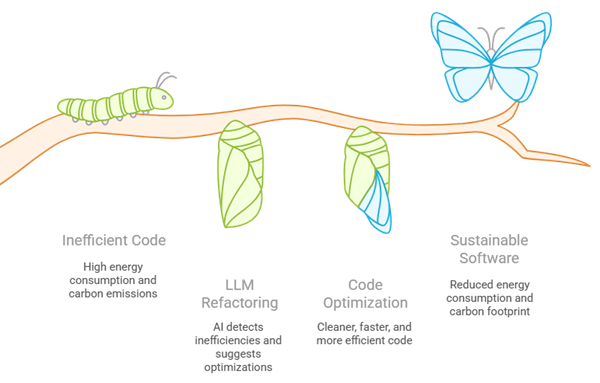
From Code to Carbon
For decades, software performance was measured by speed and scalability. Energy efficiency was a secondary concern, often overlooked amid rapid product cycles. Yet, inefficient algorithms and redundant code silently consume vast amounts of energy across data centers worldwide. Each poorly optimized loop or bloated process contributes incrementally to power usage, and collectively, to global emissions.
The Role of Large Language Models
Large Language Models (LLMs), originally celebrated for their ability to write text and generate code, are now finding purpose in code refactoring, the process of restructuring existing code to make it cleaner and more efficient without altering its functionality. Trained on vast repositories of open-source code, these models can detect inefficiencies, simplify logic, and propose optimized alternatives in seconds. Unlike traditional tools, LLMs “understand” intent. They don’t just flag errors; they interpret patterns, recommend improvements, and help align code with modern best practices. This contextual intelligence allows them to suggest solutions that balance performance, readability, and sustainability.
Optimizing for a Sustainable Future
When code runs faster and consumes fewer resources, the benefits cascade: reduced CPU time, lower energy consumption, and smaller operational costs. At scale, across millions of software deployments, these optimizations translate into measurable reductions in carbon emissions. LLM-assisted refactoring, therefore, becomes more than a technical upgrade; it’s an environmental intervention.
Looking Ahead
While the energy required to train large AI models remains significant, the ongoing application of LLMs in code maintenance could offset that cost over time by improving the efficiency of global software systems. The next chapter of computing may not be written solely in new languages or frameworks, but in intelligent code refinement, where AI helps humans write not just better software, but cleaner, greener software for the planet.
Conclusion
In essence, LLM-driven code refactoring marks a pivotal step toward sustainable computing, where innovation and environmental consciousness converge. By empowering developers to create cleaner, faster, and greener software, AI is helping shape a more efficient and eco-friendly digital future.