
 English | EN
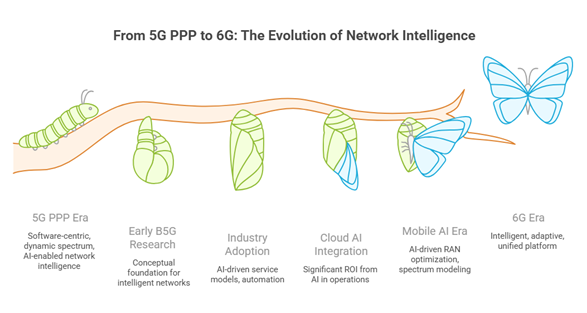
The transition from the 5G Public Private Partnership (5G PPP) to early 6G development illustrates how Beyond 5G concepts have progressed from early research to practical relevance. Early work introduced software‑centric network architectures, AI‑enabled intelligence, and adaptive control mechanisms at a time when cloud scalability, real‑time data processing, and automation platforms were not yet mature. Despite these constraints, this research established the conceptual and architectural foundations now shaping telecommunications evolution.
Industry analyses published between 2025 and 2026 increasingly validate the assumptions of early Beyond 5G studies. Telecom operators are shifting away from infrastructure‑centric differentiation toward intelligence‑driven, automated, and customer‑centric operating models. Network performance alone is no longer sufficient. Differentiation now depends on AI‑based orchestration, autonomous operations, and data‑driven service intelligence [1], consistent with early predictions that future networks would require continuous adaptation and self‑optimization.
This shift is occurring at a critical point, as large‑scale 5G deployments continue while operators are also expected to contribute to the definition of 6G. Industry outlooks highlight growing pressure to modernize operating models, adopt AI‑native architectures, and transition toward software‑defined networks [2]. The challenges emphasized, including agility, scalability, and operational complexity, closely reflect those identified in early Beyond 5G frameworks.
A key enabler of this transition is the convergence of hyperscale cloud computing and advanced artificial intelligence. AI has moved beyond experimental trials and is now embedded in core operational processes such as network automation, service management, and customer engagement. Microsoft’s 2026 analysis reports significant returns on AI investments, confirming that intelligence has become a central component of telecom business strategy rather than a future objective [3]. In this context, the primary limitation of early Beyond 5G research was infrastructural rather than conceptual, namely the lack of cloud‑scale platforms capable of supporting real‑time, data‑intensive intelligence.
Advances in radio access and network domains further reinforce this evolution. Open RAN, AI‑assisted RAN optimization, advanced spectrum modeling, and extremely large aperture antenna systems are driving the industry toward what is increasingly described as a Mobile AI Era [4]. These developments demonstrate that managing complex radio environments and high‑density connectivity requires tight integration between communications and large‑scale computational resources.
In parallel, the competitive landscape is intensifying. Hyperscale cloud providers are expanding into connectivity through fiber deployment, RAN virtualization, and enterprise communications platforms, increasing pressure on traditional telecom operators [5]. At the ecosystem level, connectivity is also becoming more heterogeneous, spanning terrestrial and non‑terrestrial networks, multi‑orbit satellite systems, global eSIM platforms, MVNO ecosystems, and AI‑enabled customer interaction models [6]. In such environments, intelligence is essential to ensure resilience, performance optimization, and consistent user experience.
The progression from 5G PPP to early 6G development hence confirms the technical validity of the Beyond 5G vision. The key change lies not in the direction of innovation but in the maturity of enabling technologies. Cloud‑native architectures, scalable AI platforms, edge computing, and autonomous orchestration now provide the operational foundation required to implement concepts previously explored at a theoretical level. Consequently, telecommunications networks are evolving from static and reactive systems toward predictive, context‑aware, and intelligent infrastructures.
From this perspective, 6G represents more than incremental performance improvements. It reflects a structural convergence of connectivity, computation, and intelligence into a unified and adaptive platform, defining the architectural basis for next‑generation communication systems.
References
[1] C. Sbeglia, “Five telecom trends for 2026: Intelligence, automation, and connectivity ‘redefined’,” RCR Wireless News, Nov. 6, 2025.
[2] D. Van Dyke, D. Littmann, J. Fritz, D. Stewart, and P. Raman, “2025 global telecommunications outlook,” Deloitte Insights, Feb. 20, 2025.
[3] S. Candiani, “Microsoft accelerates telecom return on intelligence with a unified, trusted AI platform,” Microsoft Industry Blogs, Feb. 24, 2026.
[4] “Shaping the future: AI, 6G, and cloud innovation redefine telecom infrastructure in 2025,” TeckNexus, May 7, 2025.
[5] “Deloitte’s 2025 telecom forecast highlights AI and 6G disruption,” The Silicon Review, Apr. 10, 2025.
[6] “Juniper Research reveals top 10 telecom trends for 2026,” TelecomLead, Nov. 6, 2025.