
 English | EN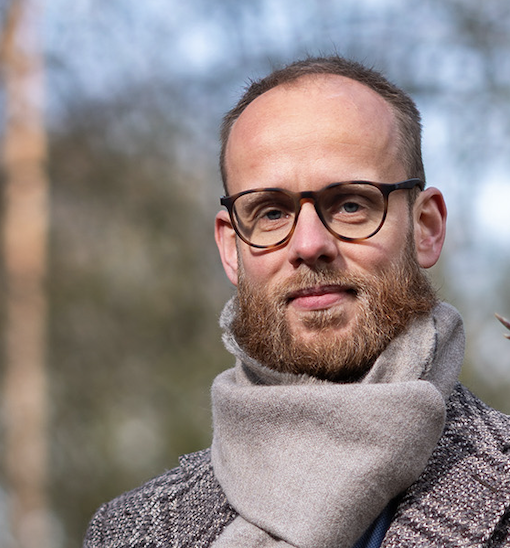
When Thijs Pepping walked on stage, he looked less like a philosopher and more like an experiment. And in a way, he was one. As he told the audience: “At some point, I stopped studying AI and started living it.”
His keynote, “Living an Algorithmic Life,” was not about code or computation — it was about what happens when human routines, emotions, and even relationships become guided by algorithms. What began as a research curiosity became a lifestyle experiment in what it means to be human in a world of digital decision-making.
From Researcher to Guinea Pig
Pepping started by reflecting on the rapid intimacy people are developing with AI tools.
“When we began writing our report last year,” he said, “most people used ChatGPT for work —editing texts, generating ideas. Now, in 2025, they use it for life: for therapy, purpose, even meaning.”
He showed a clip of a young man who confessed he had become “an extension of ChatGPT.” The man described how he let the chatbot plan his weekends, advise his relationship, even suggest vitamins for a broken finger. “It knows how to live my life better than I do,” he said cheerfully. Pepping smiled: “Anyone recognize themselves?” Laughter rippled through the room. So began his experiment: to test what it really means to live by algorithms.
What is an Algorithm, really?
Before diving into his experiences, Thijs gave a short history lesson. The word algorithm, he reminded the audience, comes from the 9th-century mathematician Al-Khwarizmi. “So, the original algorithm had nothing to do with computers,” he explained. “It simply meant a list of instructions to solve a problem.”
He turned this into a running joke. “How to start your car in winter? Take key. Insert. Curse. Call your mechanic. Done. That’s an algorithm.” From there, he unfolded a delightful cascade of examples: cooking as an algorithm (“Problem: hunger. Solution: recipe.”), waking up (“Problem: you have to go to work but don’t want to. Solution: snooze. Repeat.”), and even love (“Problem: connection. Solution: the six-second kiss or the 20-second hug.”). “Every day I hugged my wife for 20 seconds — very unromantic, but chemically effective,” he laughed. The audience chuckled, but his point was serious: life is already algorithmic, shaped by habit, repetition, and optimization.
When Algorithms Move In
Companies, he warned, have long understood this. Fitness apps nudge us to close our rings, and AI companions whisper real-time advice. “Their commercials,” Pepping said, “are eerily proud: ‘I don’t plan my week — I just do what I’m told.’”
He cited Bryan Johnson, the millionaire who spends $2 million a year following an algorithmic health regime called the Blueprint. “And apparently, it’s working,” Pepping said. “He claims his biological age only increases every two years.” Then, with a grin: “Meanwhile, I’m just proud if I remember to floss.” The question, he asked, is clear: “When does improving your algorithm become losing your humanity?”
Experiment 1: The Second Brain
Pepping’s first project was to build a “second brain.” Using an AI note-taking tool, he recorded all his conversations — work meetings, family chats, even arguments. The system analyzed and linked them, creating a network of his life.
“It’s like I have an assistant who remembers everything — especially the things I wish it didn’t,” he joked. Yet it changed how he listened. “If you know that every word will be stored forever, you start to speak differently. You start to think differently.”
Eventually, he realized the danger: “When my memories fade, the AI’s version becomes more convincing. But the AI only keeps the highlights — what happens to the importance of forgetting?”
Experiment 2: Quantifying the Self
His second experiment was to quantify his life completely. “If it moved, I measured it,” he said. Sleep, calories, exercise, even minutes spent smiling. After eight months, he knew what he was doing wrong — but also stopped knowing why he was doing anything. “It’s easy to forget that joy and love don’t fit neatly on a dashboard,” he said. “You can optimize your diet and still feel starved.”
Experiment 3: Algorithmic Groceries
Next came groceries. Pepping uploaded all his shopping data to analyze his habits and went vegan for six months. “The AI helped me discover I was low on zinc — and very high on tofu.” He laughed about joining the ‘Buy European’ movement, only to find himself using an American AI to do it. “Not my smartest move,” he admitted. His conclusion: “Each large language model has its own worldview. I want transparency — AI should come with personality cards listing its biases and values.”
Experiment 4: Raising a Child in the Algorithmic Age
Perhaps the most touching story was about his son. Together, they used AI to write a bedtime song about farm animals. “For months, that’s all he wanted to hear,” Pepping said. But he and his wife also signed a ‘smartphone-free childhood’ pact: no screens until age twelve. “Yes, we created an AI song — but we’re terrified of what that same technology might do to him.” When his second son was born, he added, “Just him
being there changed my biology — oxytocin up, testosterone down. That’s the kind of algorithm you can’t upload.”
Lessons from a Life on Autopilot
Pepping closed with five reflections — the kind no algorithm could generate:
- Relationships don’t fit in spreadsheets — they’re what make life worth living.
- An algorithmic life risks becoming a mechanistic one — you might get efficiency but
lose meaning. - Cognitive offloading isn’t new — but now it’s identity-changing.
- Autopilot demands a destination — know where your algorithms are taking you.
- Free will is a muscle — you must practice it.
He ended with a wry smile: “So yes, I’ve acted like a fool. But the algorithmic life is coming for us all. My advice? Try it — but don’t forget to ask why.”
The audience applauded warmly, half amused, half unsettled. Thijs Pepping had done what few researchers dare: he didn’t just study the age of algorithms — he lived it, one data point, one hug, and one six-second kiss at a time.
Get your copy of the Autopilot Yes/No Report.
Please note – This report was created by almost exclusively using available AI-tools except for minor editorial tweaks and some limited lay-out changes.