
 English | EN
Imagine, a college student sits in a small café, working on assignments. He opens an AI chatbot and types a simple request: “Can you help me summarize this article?” In seconds, he gets a clear, well-written answer. It feels instant, almost effortless. What he does not see is what happens behind that moment. His request travels through a vast digital infrastructure: powerful servers and thousands of specialized chips working in sync (Jiang, 2024). These systems do not just “think”, they compute at enormous scale, running billions of operations in the background to produce a single response. Even a short prompt can trigger a surprisingly complex chain of processing. And that convenience comes with a hidden cost.
Modern AI depends heavily on high-performance hardware, especially GPUs, which are designed to handle the intense mathematical workloads required for training and running models. But these chips consume significant electricity and generate a lot of heat. As a result, data centers must run large-scale cooling systems continuously just to keep everything stable. So, AI is not only powered by electricity, but it also requires energy to prevent itself from overheating.
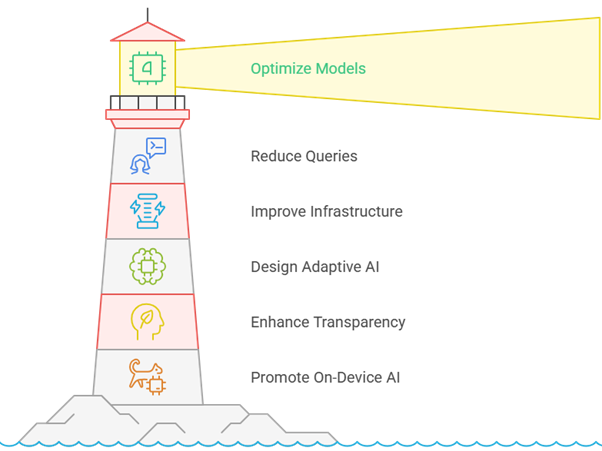
Not all AI systems are equally demanding. Smaller, optimized models – AI models that are specifically designed to perform tasks efficiently by reducing computational complexity, memory usage, and energy consumption while still maintaining strong performance – can handle many everyday tasks using far fewer resources. In recent years, there has been growing interest in building more “lean” AI systems that prioritize efficiency over sheer scale. This shift is often discussed under the broader idea of sustainable computing or Green IT.
Users also play a role. Repeated unnecessary queries such as asking the same question multiple times, requesting overly detailed outputs that are not needed, or using advanced AI models for very simple tasks can increase energy consumption and computing demand when multiplied across millions of users. Generating large outputs without need or relying on heavy models for simple tasks also adds to the environmental impact of AI systems. Meanwhile, developers and companies can reduce this impact by optimizing architecture, improving training methods, and choosing energy-efficient infrastructure.
Looking forward, the tech world can go even further by designing more responsible and efficient AI systems from the ground up. Instead of always scaling bigger models, companies can build adaptive AI that uses only the minimum computing power needed for each task. AI systems could also become energy-aware, routing workloads to data centers powered by renewable energy when possible. Another important step is transparency, showing users the approximate energy or environmental cost of their prompts, helping people make more conscious choices. In addition, more AI tasks could run directly on personal devices using smaller models, reducing dependence on large data centers, while companies collaborate on shared, optimized models instead of repeatedly building resource-heavy systems from scratch.
Artificial Intelligence is becoming deeply embedded in daily life, but its cost is not always visible. Every prompt is small on its own, but collectively they represent a significant demand for global computing resources. The challenge ahead is not just making AI more powerful, but making it more responsible, efficient, and sustainable for the future.
Next time you type a prompt, will you think about its unseen cost?
What if every prompt became a conscious choice?
References
Jiang, Z. a. (2024). MegaScale: Scaling large language model training to more than 10,000 GPUs. 21st USENIX Symposium on Networked Systems Design and Implementation (NSDI 24), (pp. 745–760).