
 English | EN
A few weeks ago, I asked a simple question on LinkedIn:
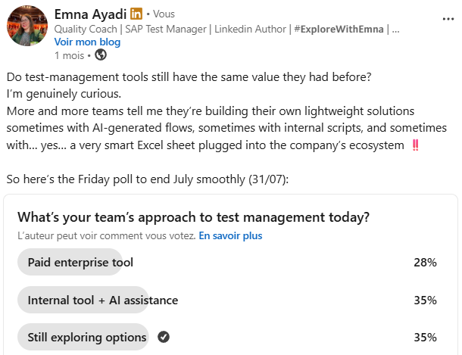
What is your team’s approach to test management today?
Honestly, I expected paid enterprise tools to be the clear winner.
The results surprised me.
- 35% use internal tools with AI assistance
- 35% are still exploring options
- 28% rely on paid enterprise tools
The most interesting finding is not that enterprise tools came last.
The real surprise is that 70% of respondents are either building their own solution or still looking for one.
That made me wonder:
Are test management tools losing the value they once had?
The Golden Age of Test Management Tools
For many years, test management tools were the natural choice for testing teams.
They helped organizations:
- Store test cases
- Track execution
- Produce reports
- Ensure traceability
- Support audits and compliance requirements
In large organizations, these tools became an essential part of the testing process. They provided a common language and a centralized place to manage testing activities.
However, the testing landscape has evolved significantly.
Why More Teams Are Choosing Lightweight Solutions
Today, many teams work differently.
Some manage their testing directly in Jira or Azure DevOps.
Others build internal portals connected to their own ecosystem.
And yes, some teams still rely on a surprisingly powerful Excel spreadsheet.
The objective is often the same: keep things simple.
Rather than adapting their way of working to fit a tool, teams increasingly build solutions that fit their own context, constraints, and processes.
This trend raises an interesting question:
Are organizations moving away from standardized platforms in favor of more flexible approaches?
Early on, I believed that working with the latest tools was essential for learning and professional growth. I thought modern tools automatically meant modern practices.
Then I joined a project that had no dedicated test management tool at all.
Everything was managed through Excel spreadsheets and PowerPoint presentations.
At first, it felt like a limitation.
In reality, it became one of the most valuable learning experiences of my career.
Without a specialized platform, we had to think carefully about:
- What information people actually needed
- How to make testing visible
- How to share insights efficiently
- How to ensure transparency across the team
The focus shifted from maintaining a tool to enabling collaboration.
And surprisingly, it worked.
How Far Can Excel Really Go?
That experience led me to explore a question many testers rarely ask:
How far can Excel go as a test management solution?
The answer is simple:
Much further than most people think.
Of course, Excel is not a replacement for every enterprise platform.
However, experimenting with simple tools helped me better understand the real purpose of test management.
The value was not in the tool itself.
The value was in making information visible, facilitating discussions, supporting decision-making, and creating a shared understanding of quality.
The Hidden Cost Nobody Talks About
When discussing test management tools, we often focus on features, integrations, and licensing costs.
But another question deserves attention:
What is the cost of maintaining the system itself?
Consider the following:
- How many test cases have not been reviewed for months?
- How many dashboards are generated but rarely consulted?
- How many reports exist because a process requires them rather than because someone uses them?
Sometimes the challenge is not managing tests.
It is managing the management of tests.
The Question Has Changed
For many years, organizations asked:
Which test management tool should we buy?
Today, a better question may be:
What problem are we trying to solve?
If a commercial platform solves the problem, it is excellent.
If an internal solution works better, that is equally valid.
If AI can simplify part of the process, it will be even better.
The answer depends on the organization’s context, constraints, and objectives.
Individuals and Interactions Still Matter Most
The poll results reminded me of one of my favorite principles from the Agile Manifesto:
“Individuals and interactions over processes and tools.”
This does not mean tools are unimportant.
It means tools should support collaboration rather than become the center of attention.
The best test management solution is not necessarily the most feature-rich or expensive one.
It is the one that helps people collaborate, make informed decisions, and build confidence in product quality.
Final Thought: Confidence Matters More Than Tools
Perhaps we have been asking the wrong question.
Instead of asking, “Which test management tool should we use?”
We should be asking: “What is the simplest way to build confidence in quality?”
Because tools do not create confidence, people do.
Tools merely support conversations, collaboration, and decisions that make confidence possible.What about your team? Has your approach to test management changed over the past few years, or are traditional tools still delivering the value you need?