
 English | EN
For years, artificial intelligence remained locked inside our screens: a chatbot in an app, a copilot in a browser, a recommendation in a business tool. But a new phase is emerging: AI that can assist users in their physical environment without forcing them to take out a phone or interrupt what they are doing.
Smart glasses are not just a tiny new screen. They combine a camera, microphone, speakers, and in some cases a display in the lens, along with voice recognition, computer vision and generative AI models. The objective is clear: move AI from a consultation logic to an in-context assistance logic.
This trend is visible in major announcements. Meta introduced Orion as AR glasses designed to bridge the physical and digital worlds, while Google has demonstrated Android XR and Gemini prototypes that can see and hear what the user perceives in order to provide useful information at the right time. [1][2][3]
From the smartphone to wearable AI: a shift in interface
The smartphone trained us to follow a simple sequence: search, click, read, respond. Smart glasses introduce a different logic: perceive, understand, assist, act. The disruption is therefore not only about hardware; it is fundamentally about the interface.
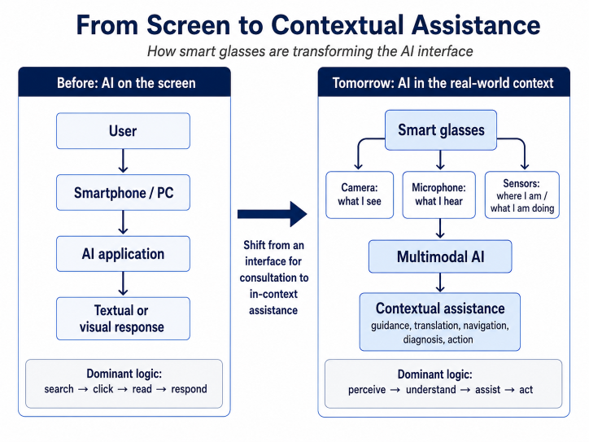
In this model, the user no longer interacts only with an application. They benefit from an assistant that interprets the immediate context. The camera provides visual perception, the microphone provides auditory context, sensors provide situational information, and multimodal AI orchestrates these signals into practical guidance.
Why now?
Several trends are converging. Multimodal AI models can now process text, images, audio and sometimes video. Components are getting smaller: cameras, microphones, embedded processors, micro-OLED displays, waveguides and gesture sensors. At the same time, hands-free use cases are becoming strategically important in jobs where taking out a phone is impractical: maintenance, logistics, healthcare, field operations, training, inspection and customer service.
Recent announcements confirm this momentum. At Meta Connect 2024, Meta unveiled Orion. At Google I/O 2025, Google demonstrated Android XR glasses connected to Gemini. In 2026, Google also presented two categories of intelligent eyewear: audio-only glasses and display-enabled glasses, both designed to provide assistance without requiring the user to pull out a phone. [1][2][4]
Snap is pursuing a developer-oriented approach with Spectacles and Snap OS, announced at Snap Partner Summit 2024, followed by a new generation of Specs planned for 2026. This shows that the battle is not only about hardware. It is also about platforms, SDKs, application ecosystems and native AR experiences. [5][6]
Real-world use cases: where smart glasses already create value
1. Logistics: guiding operators without interrupting the task
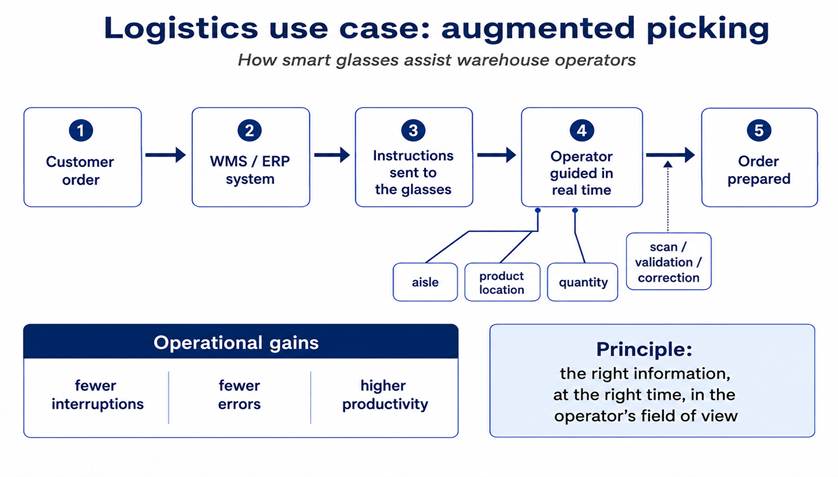
In a warehouse, every second counts. DHL tested smart glasses with Ricoh and Ubimax in the Netherlands for vision picking. Operators could see order-picking information directly in their field of view: aisle, product location and quantity. DHL reports that the pilot improved picking efficiency by 25%. [7]
This case matters because it shows that smart glasses are not only a consumer gadget. They can reduce interruptions, limit errors and improve productivity in highly operational processes.
2. Healthcare: reducing administrative burden and enabling remote input
A pilot at NHS England in which community nurses use smart glasses during home visits. With patient consent, the device can transcribe the appointment into an electronic record and share a live video feed with hospital colleagues to obtain additional clinical input. [8]
The point here is not to replace the caregiver. It is to give them back clinical time, streamline documentation and connect field activity more easily with remote expertise.
3. Industrial maintenance: connecting the technician and the expert
Smart glasses are particularly well suited to industrial environments. A technician can keep both hands free, follow step-by-step instructions, share their point of view with a remote expert and receive live annotations or guidance.
However, this use case must be approached carefully. A 2025 study on AR head-mounted displays in hazardous industrial settings shows that some devices may degrade situational awareness and safety, especially when they interfere with obstacle perception or increase cognitive load. For enterprises, an AR/AI pilot should therefore assess not only productivity, but also safety, ergonomics, fatigue and field acceptance. [12]
4. Accessibility: describing, reading and guiding
Smart glasses can also become an accessibility interface. The WhatsAI research project explores the use of Meta Ray-Ban glasses as an extensible platform for blind and low-vision users, with features such as scene description, object detection and OCR. [10]
5. Personal agents: from assistance to action
Another emerging area is wearable AI agents. The VisionClaw research project, published in 2026, experiments with an always-on agent running on Meta Ray-Ban glasses. It combines live perception, voice commands and task execution: adding a real-world object to a shopping cart, generating notes from a physical document, creating an event from a poster or controlling IoT devices. [11]
Target architecture for the enterprise
For an organization, the question is not: “Should we buy smart glasses?” The right question is: “Where does a hands-free, contextual interface connected to AI create measurable value?”
A relevant architecture does not stop at the wearable device itself. It connects the field, the glasses, a mobile or edge layer, AI services and business systems. Most importantly, it adds cross-functional governance: consent, logs, audit, cybersecurity, compliance and human oversight.
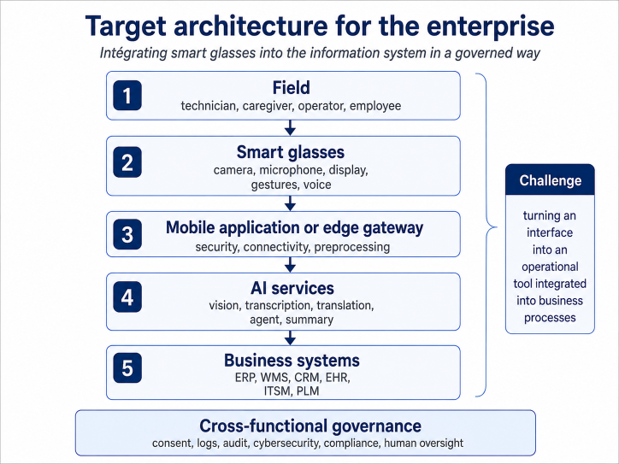
This architecture highlights a key point: smart glasses create value only if they are integrated into business processes. Real-time translation is useful. Real-time translation connected to a customer support workflow is even more useful. An embedded camera is interesting. A camera connected to a knowledge base, a ticketing system and a validated procedure becomes an operational tool.
Risks to address from the outset
Smart glasses raise more sensitive questions than smartphones because they potentially capture what the user sees and hears. The issues to address from the start therefore include consent, privacy, biometric data, conversation confidentiality, cybersecurity, use in sensitive areas, dependency on AI cloud services, physical safety and cognitive fatigue.
In an enterprise setting, it is not enough to check that a capture LED is visible. Organizations need clear usage rules: restricted areas, anonymization, retention periods, legal review, user training, human oversight and approval for sensitive uses. Research on AR safety also reminds us that poorly designed displays can distract users or reduce risk perception. [12]
Conclusion
Smart glasses mark an important step in the evolution of AI. After conversational AI, we are entering the era of situated AI: AI that understands context, supports the user in the real world and can help them act at the right moment.
This transition will not happen overnight. Many challenges remain: battery life, comfort, cost, privacy, safety, social acceptance and integration into enterprise systems. But the signals are strong: major technology players are investing, professional use cases are multiplying and prototypes are becoming more credible.
For organizations, the challenge is not to chase a trend. It is to identify the situations where AI must leave the screen and become a true field assistant. For a broader perspective on how XR can move beyond experimentation and become a scalable business capability, you can also read our article: “Extended Reality & Business: From Hype to Scaled Adoption.” [13]
References
[1] Meta – Introducing Orion, Our First True Augmented Reality Glasses. https://about.fb.com/news/2024/09/introducing-orion-our-first-true-augmented-reality-glasses/
[2] Google – Watch Google’s Android XR glasses demo from I/O 2025. https://blog.google/products-and-platforms/platforms/android/android-xr-glasses-demo-io-2025/
[3] Google – A new look at how Android XR will bring Gemini to glasses and headsets. https://blog.google/products-and-platforms/platforms/android/android-xr-gemini-glasses-headsets/
[4] Google – Intelligent eyewear with Gemini is coming this fall. https://blog.google/products-and-platforms/platforms/android/android-xr-io-2026/
[5] Snap – SPS 2024 | Introducing New Spectacles and Snap OS. https://newsroom.snap.com/sps-2024-spectacles-snapos
[6] Snap – Snap to Launch New Lightweight, Immersive Specs in 2026. https://newsroom.snap.com/launch-specs-2026
[7] DHL – DHL successfully tests augmented reality application in warehouse. https://www.dhl.com/global-en/delivered/innovation/dhl-successfully-tests-augmented-reality-application-in-warehouse.html
[8] NHS England – NHS trials smart goggles to give nurses more time with patients. https://www.england.nhs.uk/2022/08/nhs-trials-smart-goggles-to-give-nurses-more-time-with-patients/
[9] XREAL / PR Newswire – XREAL Announces Groundbreaking Collaborations at CES 2025. https://www.prnewswire.com/news-releases/xreal-announces-groundbreaking-collaborations-at-ces-2025-302344140.html
[10] Zaman et al. – WhatsAI: Transforming Meta Ray-Bans into an Extensible Generative AI Platform for Accessibility. https://arxiv.org/abs/2505.09823
[11] Liu et al. – VisionClaw: Always-On AI Agents through Smart Glasses. https://arxiv.org/abs/2604.03486
[12] Camacho-Fidalgo et al. – Analyzing the Impact of Augmented Reality Head-Mounted Displays on Workers’ Safety and Situational Awareness in Hazardous Industrial Settings. https://arxiv.org/abs/2503.04075
[13] SogetiLabs – Extended Reality & Business: From Hype to Scaled Adoption. https://labs.sogeti.com/extended-reality-business-from-hype-to-scaled-adoption/