
 English | EN
Artificial intelligence is now becoming a foundation for many critical applications, yet it also introduces a level of uncertainty that traditional cybersecurity approaches struggle to manage. Unlike conventional systems, an AI model exhibits non-deterministic behavior: it learns, generalizes, and sometimes fails under conditions that were not observed during training. This very nature makes AI systems both powerful and vulnerable. Attacks such as data poisoning or adversarial examples directly exploit this sensitivity, without necessarily compromising the underlying infrastructure 1, 2, 3.
In this context, securing an AI system is no longer just about protecting a perimeter or reinforcing access controls. It is primarily about understanding how the system behaves in real-world and evolving conditions, including those that were not anticipated during design. This is where testing takes on a completely different role. It is no longer just about verifying that “everything works,” but about exploring what could go wrong, anticipating potential drifts, and making visible behaviors that would otherwise remain hidden.
Testing an AI system ultimately means confronting it with reality. For instance, a fraud detection model may behave reliably under normal conditions but fail when input distributions shift, such as during seasonal transaction spikes, leading to undetected anomalies. This involves multiple complementary testing dimensions: data testing (quality, bias, drift), model testing (robustness, adversarial resilience), and system-level evaluation (integration, monitoring, and stability over time). This holistic approach, widely adopted in AI engineering practices, reflects a simple idea: a model is never isolated, and vulnerabilities can emerge at any level 4.
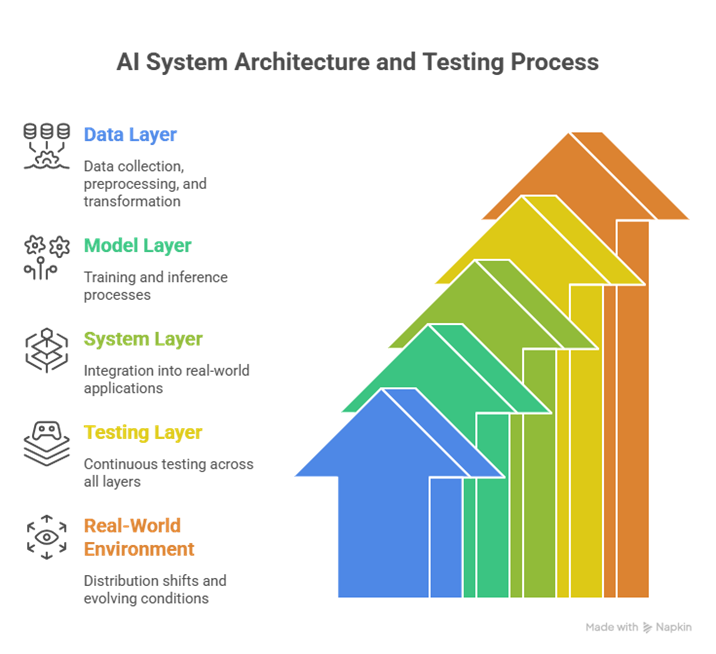
What makes testing even more critical is its proactive dimension. Today, we do not simply observe errors, we actively try to trigger them. Practices such as red teaming follow this logic by simulating attacks and pushing systems to their limits and attempting to deceive them. The goal is not to weaken the system, but rather to understand where its limits lie. These tests reveal subtle weaknesses, such as latent bias, inconsistent responses, or potential rule bypasses, which could become critical in production.5
This perspective is increasingly reflected in international frameworks and standards. Recent work highlights that AI system security cannot be reduced to attack prevention alone. It must be embedded in a broader notion of trust, including robustness, reliability, and the system’s ability to behave consistently in complex environments. 6, 7
In practice, this also changes how systems are designed. Testing is no longer a final step. It becomes a continuous process, embedded from early design phases and maintained throughout the lifecycle. More mature organizations multiply testing scenarios, leverage simulation environments, and continuously evaluate models to detect distribution shifts and drift over time.8
Ensuring the security of AI systems therefore requires continuous and rigorous testing. In environments where behavior cannot be fully predicted, testing remains the most effective way to reveal hidden vulnerabilities and gain a deeper understanding of model behavior. For this reason, it stands today as the first line of defense, not only for securing AI systems, but for building trust in their real-world deployment.