
 English | EN

This Used to Cost Millions.
Not long ago, building a real-time digital twin of a regional shopping mall would have required millions of dollars and a small army. I built this one with a frontier AI model.
694,000 square feet. 61 tenants. 163 live devices. 4,000+ people inside at any given moment. Millions in annual energy flow. All modeled. All simulated. One pane of glass.
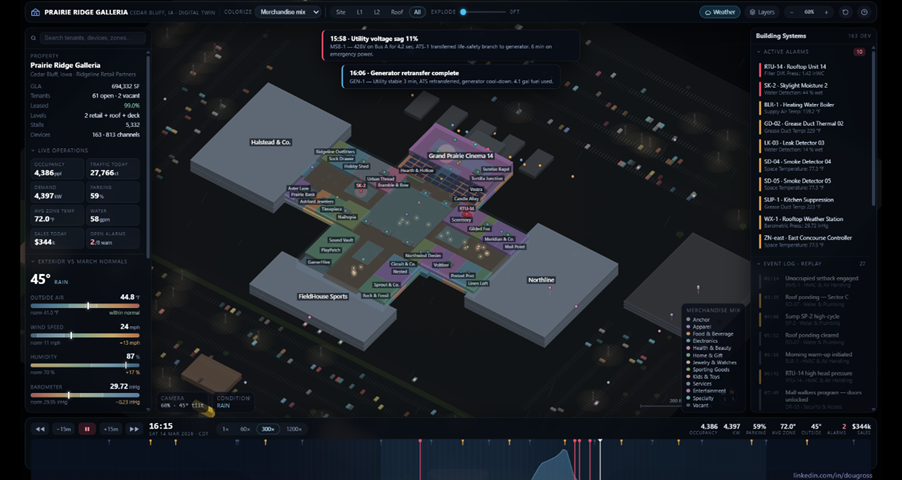
A Digital Twin of a Shopping Mall – Demo
For CRE owners, this can be a great way to monitor your physical investments.
For P&C carriers, this capability lets you tap into valuable risk engineering telemetry.
Prairie Ridge Galleria. Cedar Bluff, Iowa*.
694,000 square feet. 61 tenants. Two retail levels and a food deck. 5,300+ parking stalls. 163 building devices feeding live telemetry. * It’s a fictional mall with its heritage in several real malls.
On the screen, it looks clean. Almost calm. But it’s not. It’s a living system. With all kinds of stuff going on, every minute of the day.
Not a 3D Model. Not a Dashboard.
A real digital twin isn’t a photo. At its best, it’s “reality-vision”.
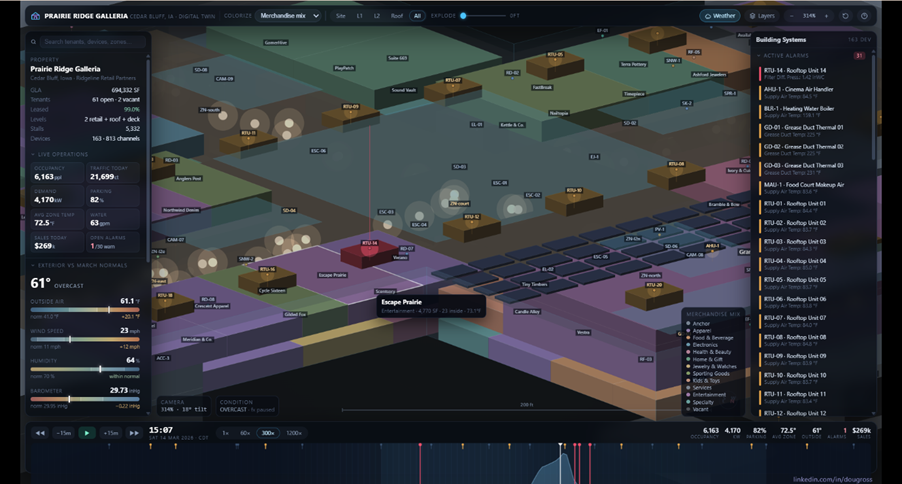
Something’s going on here!
Every tenant exists in a physical context, that’s traditionally hard to see in aggregate. HVAC load shifts with occupancy. Occupancy shifts with weather. Weather shifts parking patterns. Parking patterns shift revenue. The mall’s a system.
The Mall as a System: Twin Simulator
Retail real estate is deceptively complex. Energy demand fluctuates by the hour. Parking utilization moves with micro-events. Tenant mix affects traffic. Traffic affects cooling loads. Cooling loads are cost.
In the Mall Twin Simulator (seen in these screenshots):
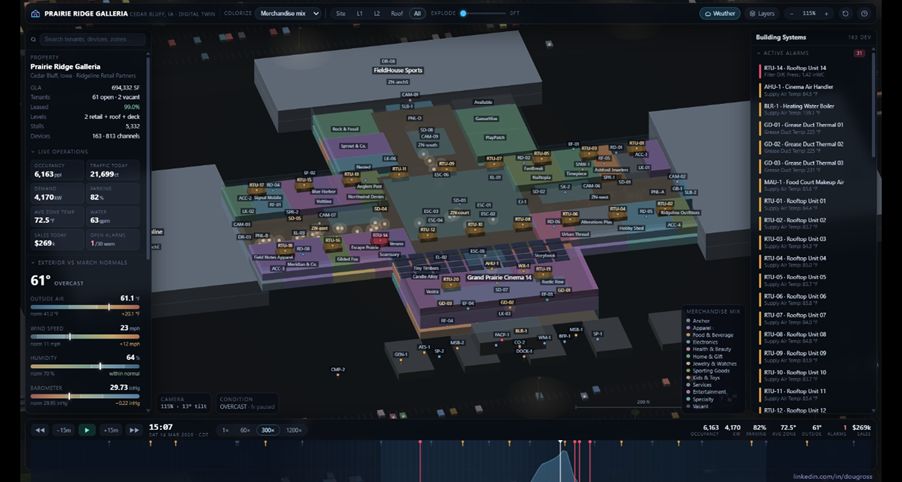
If I owned a mall, I’d want one of these.
You can see live occupancy. Live traffic counts. Energy demand. Water consumption. Average zone temps. Parking utilization. Daily sales.
All in one operational cockpit.
Weather Isn’t Background Noise
Rain hits, and it hits hard. Humidity spikes way above historical averages. The wind kicks up. So… parking behavior changes. Foot traffic shifts. HVAC demand increases.
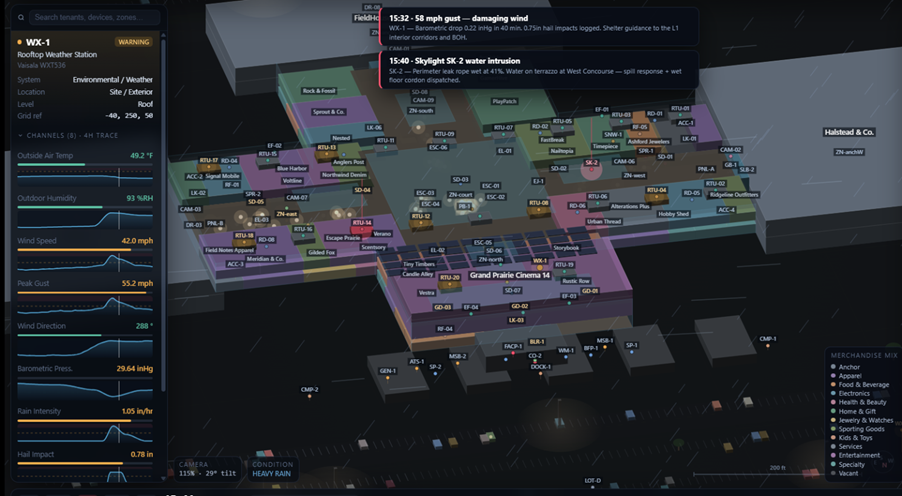
Not sure if it’s visible in this screenshot, but the rain does appear in the simulator
The twin reflects everything. All of your operational, IoT and related telemetry can now be visualized.
Exec Summary
None of this required a 20-person engineering team. You can now: Design the visualization architecture. Generate system schemas. Build event logic. Add in instrumentation and replay-the-telemetry mechanics. Scaffold the UI. Iterate. Iterate some more.
AI handled the mechanics. Humans do the system thinking. That’s the shift.
Demo link: Mall Twin Simulator