
 English | EN
Artificial Intelligence is increasingly presented as one of the key technologies shaping the future of smart cities. Combined with autonomous mobility, connected infrastructures, and future 6G communication systems, AI is expected to support a wide range of urban services, from transportation management and infrastructure monitoring to emergency response and public service optimization [1]-[4]. The promise is appealing: cities that can continuously analyze their environment, adapt to changing conditions, and support faster and more informed decisions.
Yet, beyond technological performance, a more fundamental question remains. As AI systems become involved in decisions that may directly affect citizens and public services, how can these decisions be trusted if their underlying logic remains difficult to understand?
This question is becoming increasingly important because modern AI models are often extremely effective, but also extremely complex. Deep learning systems can identify patterns and relationships in data that would be difficult for humans to discover manually. However, the same complexity that enables high predictive performance can also make these models difficult to interpret. In practice, a city operator facing an AI recommendation may not only want to know the outcome proposed by the system but also understand the factors that contributed to that recommendation [5], [8].
The challenge is not merely technical. Cities are complex socio-technical environments where operational decisions are expected to remain accountable, transparent, and aligned with public interests. Public authorities, infrastructure operators, and citizens alike need confidence that AI systems behave in a consistent and reliable manner. A highly accurate model may provide valuable recommendations, but its adoption can become difficult if stakeholders cannot understand the rationale behind its outputs [7], [8].
This is one of the reasons why Explainable Artificial Intelligence (XAI) has emerged as an active area of research. Rather than focusing solely on predictive performance, XAI seeks to provide insights into how AI systems generate their outputs and which factors influence their decisions [8]. Techniques such as SHAP and Integrated Gradients can help identify the contribution of individual input features, offering a better understanding of the behavior of complex models [5], [6].
However, explainability should not be viewed as a mechanism that magically reveals the complete reasoning of an AI system. Explanations provide useful evidence, but they remain approximations of highly complex processes. Their value lies in helping stakeholders better understand, critique, and validate AI-generated outputs. In this sense, explainability contributes not only to model interpretability but also to trust-building, operational validation, and responsible governance.
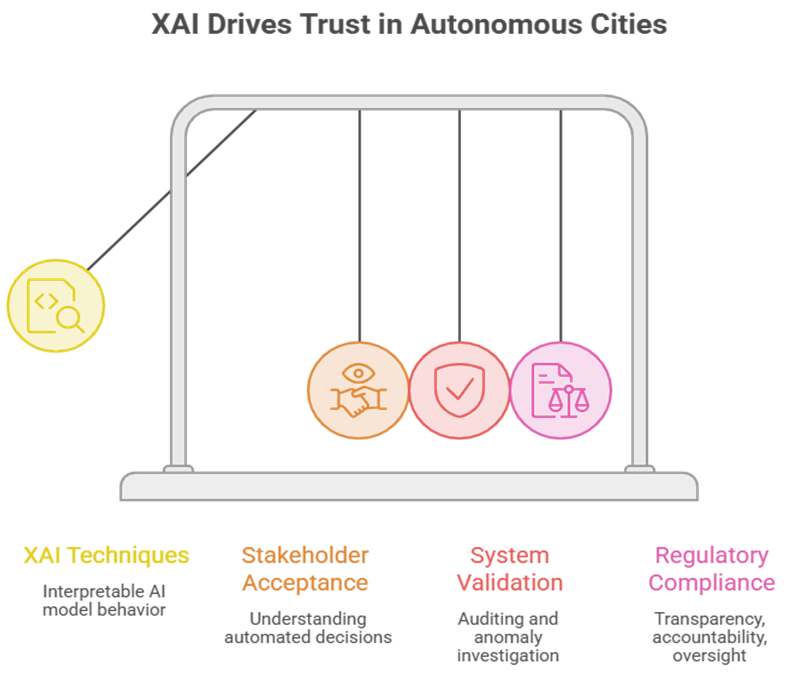
From a practical perspective, different stakeholders may require different forms of explanations. Engineers may need detailed technical information to investigate anomalies or model failures. Urban operators may be more interested in understanding the operational factors that influenced a recommendation. Citizens, meanwhile, often seek simple and understandable justifications when AI-supported decisions affect services they rely on. Effective explainability therefore requires more than technical methods; it requires explanations that are adapted to the needs of the people who will ultimately use or be affected by these systems.
This perspective is increasingly reflected in discussions around trustworthy AI. Recent governance frameworks emphasize transparency, accountability, auditability, and human oversight as essential dimensions of responsible AI deployment [7]. As autonomous urban systems continue to evolve, their evaluation will likely extend beyond traditional metrics such as accuracy, latency, or efficiency. The ability to provide meaningful explanations, understand system limitations, and maintain human control over critical decisions may become equally important criteria for adoption and acceptance [7], [8].
Ultimately, the future of autonomous cities will not depend solely on how intelligent their algorithms become. Cities are built around people, institutions, and public trust. AI can undoubtedly contribute to making urban services more adaptive and efficient, but long-term adoption will require systems whose behavior can be understood, questioned, and validated. Explainability should therefore be seen not as an optional feature added after deployment, but as one of the foundations of trustworthy urban AI, alongside rigorous testing, cybersecurity, data governance, and human oversight.
References
[1] Ericsson, The Future of 6G Networks, 2026.
[2] BCG & Qualcomm, The 6G Network Is the Future of AI, 2026.
[3] AgileTV, MWC 2026: AI, Intelligent Networks and the Road to 6G, 2026.
[4] 6G-AI, 6G and Smart Cities: Enabling the Intelligent Urban Future, 2026.
[5] S. M. Lundberg and S.-I. Lee, “A Unified Approach to Interpreting Model Predictions,” Advances in Neural Information Processing Systems (NeurIPS), 2017.
[6] M. Sundararajan, A. Taly, and Q. Yan, “Axiomatic Attribution for Deep Networks,” International Conference on Machine Learning (ICML), 2017.
[7] European Commission, Ethics Guidelines for Trustworthy Artificial Intelligence, 2019.
[8] A. Barredo Arrieta et al., “Explainable Artificial Intelligence (XAI): Concepts, Taxonomies, Opportunities and Challenges toward Responsible AI,” Information Fusion, vol. 58, pp. 82-115, 2020.