
 English | EN
Why Organizations Matter More Than We Think
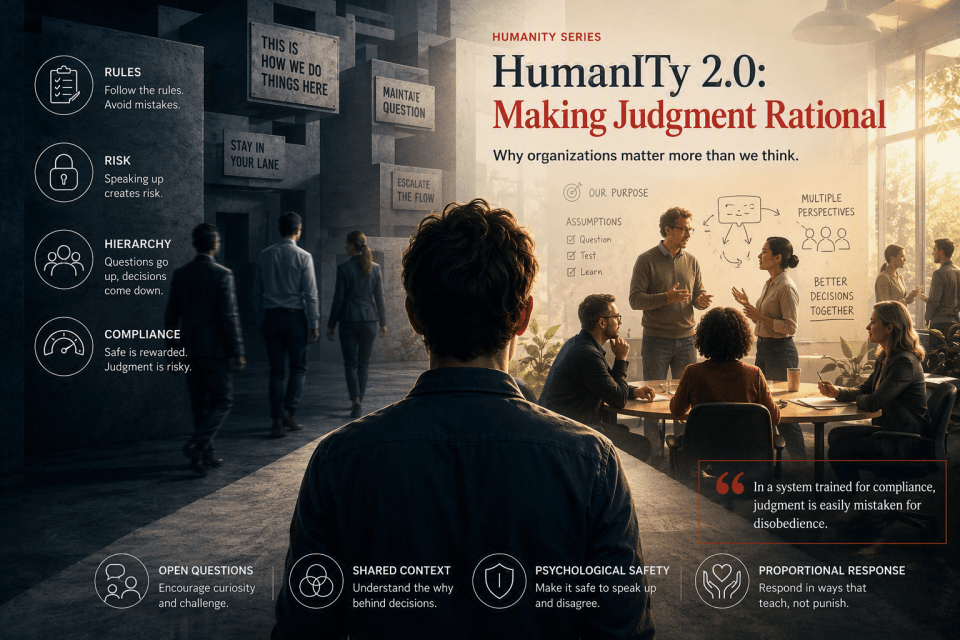
If judgment is a capability, why do intelligent, responsible and well-intentioned people sometimes fail to use it?
In the first article of this series, I explored the idea that judgment is not an innate quality but a capability that must be practised.
That raises an interesting question. If judgment is a capability, why do intelligent, responsible and well-intentioned people sometimes fail to use it?
The common explanation is often an individual one. Someone lacked courage, avoided responsibility, failed to speak up or demonstrated poor judgment.
Perhaps. But what if we are sometimes looking in the wrong place?
What if what we describe as poor judgment is occasionally a perfectly rational response to the environment people operate within?
That possibility changes the conversation entirely. The question is no longer: “Why don’t people use their judgment?” Instead, it becomes: “Does the system make judgment a rational choice?”
We Tend to Overestimate the Individual
Many organizations invest heavily in developing individuals through leadership programmes, training initiatives, competency frameworks, coaching and mentoring. All of these activities have value, but they often share a common assumption: that better outcomes result primarily from better individuals.
Yet most decisions are never made in isolation. People operate within teams. Teams operate within organizations. Organizations operate within systems of incentives, expectations, measurements and power structures. These environments continuously influence what seems reasonable to do in a given situation.
If raising concerns creates friction, remaining silent can become rational. If questioning assumptions creates risk, compliance can become rational. If speed is rewarded and reflection is penalized, rapid decisions become rational.
Not because people lack judgment, but because they adapt
Every System Trains Something
Over the last few years, I have become increasingly interested in a simple observation: every system trains something. Schools train something. Organizations train something. Processes train something. Technology trains something. Even seemingly neutral communication shapes behavior over time.
Consider two ways of communicating the same message: “These are the rules. Please follow them.” Or: “This is why the decision was made. Please help us make it work.”
The practical outcome may be identical. The learning outcome is not. The first primarily trains compliance. The second invites participation and shared responsibility.
The difference may appear subtle, but over time it becomes significant. Systems do not only coordinate behavior. They shape how people think about responsibility itself.
When Compliance Becomes Rational
Most organizations genuinely want employees who demonstrate initiative, accountability and critical thinking. At least in principle. In practice, however, organizations often send conflicting signals.
Employees are encouraged to challenge assumptions, as long as the challenge remains comfortable. They are encouraged to innovate, as long as innovation stays within approved boundaries. They are encouraged to take ownership, as long as the outcome aligns with existing expectations.
Over time, people learn these unwritten rules. The organization may officially value judgment, but daily experience teaches what is actually rewarded.
Eventually something subtle begins to happen. Using personal judgment starts to feel more risky than following procedure. Once that threshold has been crossed, compliance becomes the rational choice. The organization still asks for judgment. The system rewards obedience.
The Hidden Cost
From a management perspective, compliance often appears attractive. It creates predictability, supports consistency and reduces variation. In some contexts this is essential. Few people would want airline pilots to improvise safety procedures. Few patients would want surgeons to ignore established medical standards.
The problem is not compliance itself. The problem emerges when compliance becomes the only acceptable response.
Every organization eventually encounters situations where procedures, guidelines and past experience fail to capture the reality in front of us: unique customers, unexpected events, novel technologies, emerging risks and cases that do not fit existing categories.
These are precisely the situations where judgment becomes necessary, yet they are often the situations organizations are least prepared to handle.
The HumanITy Perspective
HumanITy suggests a different way of thinking about organizational performance. Instead of asking, “How do we make people better?” we might ask, “How do we create environments where the use of judgment becomes rational?”
This shifts attention away from individuals alone and toward the systems they inhabit. The goal is not to remove structure or accountability, or to replace processes with intuition. It is to create conditions where people can combine structure and judgment effectively.
Do people understand the reasoning behind decisions? Can alternative interpretations be discussed openly? Is disagreement treated as a threat or as useful information? Do employees feel safe raising concerns? Are mistakes only measured, or are they also examined?
These questions may tell us more about an organization’s future than any maturity model ever could.
Creating Space for Judgment
The challenge facing modern organizations is not a shortage of intelligence or data. If anything, we have more information than ever before. The challenge is creating environments where people can make sense of that information together.
Judgment develops when people are allowed to examine trade-offs, when competing perspectives can coexist, when uncertainty is acknowledged instead of hidden, and when difficult questions remain open long enough to be explored.
In other words, judgment requires space: interpretive space, relational space and conversational space. Space to ask, “Are we solving the right problem?” before rushing toward an answer.
A HumanITy Experiment
As I continued exploring how organizations shape judgment, I began noticing something interesting.
When decisions later appeared disproportionate, unnecessarily rigid or unexpectedly harmful, similar patterns often seemed to emerge beforehand.
Not identical situations. Not identical outcomes. But recurring traces in how decisions were formed.
The questions that were never asked. The assumptions that could not be challenged. The forms of knowledge that were overlooked. The speed with which conclusions appeared instead of dialogue. Over time, these observations evolved into a separate HumanITy experiment: an attempt to identify recurring signals that may help us recognize when a decision-making system is gradually losing its capacity for judgment.
I am not yet certain where that exploration will lead. But the patterns appear often enough to warrant further study.
Perhaps if judgment can be practised, it can also be observed. And if it can be observed, perhaps it can be strengthened.
A Final Reflection
When organizations experience failures, we often search for individuals to blame. Someone made the wrong decision, overlooked a warning sign or failed to act. Sometimes that assessment is fair. But sometimes it misses a deeper issue.
People tend to behave rationally within the environments they inhabit. If judgment consistently appears absent, it is worth asking whether the system itself is shaping that outcome.
Perhaps the most important question is not whether people possess judgment. Perhaps it is whether the organization makes the use of judgment possible.
Before collective judgment can emerge, something else must exist first: a system where using judgment feels safer than avoiding it.