
 English | EN
Why Human Judgment Matters More as AI Gets Better
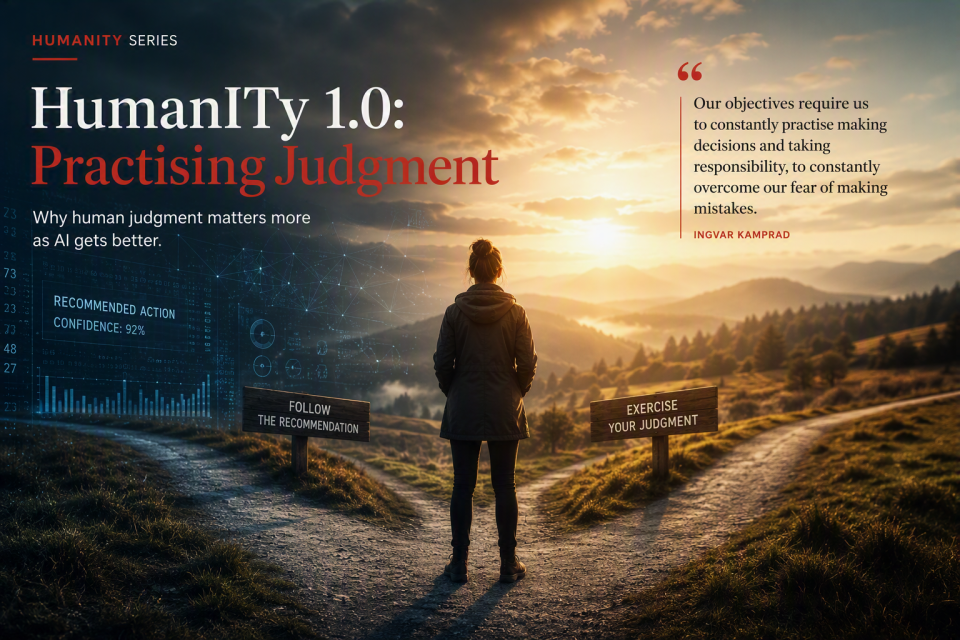
What happens to the human being who works alongside increasingly capable intelligent systems?
“Our objectives require us to constantly practise making decisions and taking responsibility, to constantly overcome our fear of making mistakes.” Ingvar Kamprad
Some quotes seem to become more relevant with time.
When Ingvar Kamprad wrote those words, he was describing a practical mindset for a growing company. Today, they can be read as something larger. Almost as a description of how human judgment itself develops.
Not as a trait. As a practice.
Over the past year, I have been exploring an idea I call HumanITy. Not as a framework. Not as a methodology. More as an experiment. A way of understanding what happens to us as intelligent systems become increasingly capable.
Most discussions about AI focus on what the technology can do. I find myself drawn to a different question: what happens to the human being who works alongside it?
As AI systems become better at generating answers, recommendations and decisions, an interesting paradox begins to emerge. The smarter our systems become, the easier it becomes to stop exercising our own judgment.
And that may be one of the most important challenges of the AI era.
From Knowledge Work to Judgment Work
For centuries, technology has helped us extend our physical capabilities. Then software helped us extend our cognitive capabilities. Now AI is helping us generate content, analyse information and support decisions at a scale that would have seemed remarkable only a few years ago.
Each step has increased productivity. Each step has unlocked new possibilities. But something else has happened along the way. The nature of human work has quietly begun to change. The value of knowing the answer is decreasing.
The value of asking the right question is increasing. The value of executing a decision is decreasing. The value of judging whether the decision should be made at all is increasing.
Perhaps we are entering an era where knowledge is no longer the scarcest capability. Perhaps judgment is.
And that raises an interesting question: if intelligent systems increasingly help us make decisions, who is helping us practise judgment?
Judgment Is a Muscle
We often talk about judgment as if some people possess it and others do not. I am not convinced.
The more I observe organizations, schools, technology projects and public institutions, the more I suspect that judgment resembles a muscle more than a personality trait.
A muscle grows through use. It weakens through disuse.
The ability to weigh competing values, navigate uncertainty, take responsibility and act without knowing the outcome does not emerge automatically. It develops through repeated exposure to situations where no rulebook fully applies. Situations where we are forced to think rather than merely comply.
Most importantly, it develops when we accept the possibility of being wrong.
This is what Kamprad’s quote points toward. Responsibility does not emerge from certainty. Responsibility emerges from practice.
The Comfort of Delegation
Historically, humans have delegated physical labor to machines. Today, we increasingly delegate cognitive labor. And in some situations, something even more significant: judgment.
Researchers have recently begun describing a phenomenon called algority: the tendency to treat algorithmic systems as sources of epistemic authority. In simple terms, we begin to experience algorithmic outputs not merely as recommendations, but as persuasive statements about reality itself.
This is not irrational. In highly complex environments, relying on systems that appear consistent, objective and data-driven can be entirely reasonable.
The attraction is obvious. Algorithms do not become tired. They do not become distracted. They do not doubt themselves. Humans do.
Yet there is a subtle trade-off hidden within this relationship. Avoiding mistakes is not the same thing as developing responsibility. Reducing uncertainty is not the same thing as strengthening judgment.
The more often a system provides the answer, the fewer opportunities we have to wrestle with the question.
Between Correctness and Responsibility
Imagine a physician reviewing a diagnosis supported by AI. A teacher evaluating a student whose situation does not fit established categories. A software engineer deciding whether a technically correct solution is also the right solution.
In each case, a recommendation may be available. But recommendations do not remove responsibility. They merely change its shape. The difficult part is rarely deciding whether a recommendation is statistically sound.
The difficult part is deciding whether it is appropriate for this situation, for these people, at this particular moment in time.
That is not a computational problem. It is a human one.
And it is here that judgment lives. Not in certainty, but in the space between competing perspectives.
HumanITy as a Design Question
HumanITy therefore begins with a simple question: can technology be designed to strengthen human judgment rather than replace it?
The goal is not to make AI more human. Nor is it to position humans as superior to machines.
Instead, it is to explore what kinds of environments help people remain capable of reflection, responsibility and moral autonomy as intelligent systems become increasingly capable.
In this sense, HumanITy is ultimately not about artificial intelligence. It is about human development.
Not what systems can do, but what systems train us to become.
The Risk of Becoming Comfortable
Most organizations aim to reduce friction. Errors are expensive. Standardization creates efficiency. Decision support improves consistency. All of these things create value.
But they also create a paradox. The safer and more predictable a system becomes, the fewer opportunities individuals have to exercise judgment.
Over time, people may retain formal responsibility while gradually losing the habit of independent evaluation. The mandate remains. The muscle weakens.
This does not happen because anyone intends it. It happens because convenience is persuasive.
A recommendation removes uncertainty. A process removes ambiguity. An algorithm removes cognitive burden. And each time they do, life becomes a little easier.
But easier is not always better. At least not for the faculties we hope will remain uniquely human.
A Final Reflection
When Ingvar Kamprad wrote about overcoming the fear of making mistakes, he was describing something profoundly human. Not efficiency. Not optimization. Practice.
Perhaps that is what judgment has always been: a continuous willingness to engage with uncertainty rather than escape from it, to make decisions without complete information, and to assume responsibility when no obvious answer exists.
AI may eventually surpass humans in many forms of analysis. It may become better at recognizing patterns, generating recommendations and predicting outcomes.
But there is one thing it cannot do for us. It cannot practise being human on our behalf. That responsibility remains ours.
And perhaps that leaves us with a question worth reflecting on: when was the last time you exercised your own judgment, not because you were certain, but because the situation required it?
In the next article, I will explore a related question: what happens when organizations unintentionally make judgment irrational?