
 English | EN
For years, quality assurance stood near the release gate. It checked whether the build was stable, whether requirements were covered, whether defects were acceptable, and whether production could safely begin. That model worked when software moved in sprints, release cycles were predictable, and human teams controlled most of the delivery rhythm.
But the new era is different. AI-generated code can move in hours. Agentic operations can change system behavior continuously. Digital journeys can degrade before a traditional quality cycle even notices. In this environment, agile itself is starting to feel too slow. Not because agile is wrong, but because the pace of change has outgrown rituals designed for human-sized batches.
This is where Agentic Quality Experience becomes critical. It shifts quality from a release checkpoint to a continuous experience intelligence layer. The question is no longer only: “Did the feature pass?” The better question is: “Did the experience hold?” Working software is now just the entry ticket. Growth comes from users who return, trust, adopt, convert, and recommend. That requires quality to move closer to the customer, closer to business outcomes, and closer to the live experience itself.
From Quality Gate to Experience Signal
The old quality model often positioned testers as the final barrier before production. They were seen as the people who slowed things down, raised defects, and blocked risky releases. In the agentic era, that framing is no longer helpful. Testers are not the brake on the ship. They are the navigators who help the organization understand whether the journey is still right for the customer.
That shift matters. A release can be technically successful and still fail the customer. The application can be available, but too slow. A ticket can be closed, but the user may still call back. A workflow can pass regression testing, but create friction that quietly damages adoption.
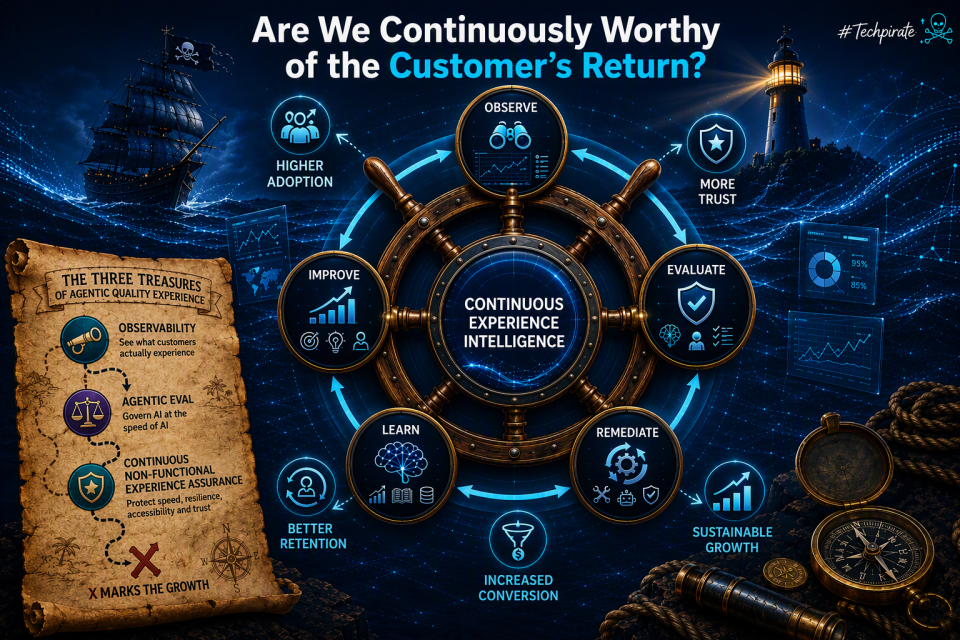
Traditional quality metrics do not always capture this. Experience-aware quality does. Agentic Quality Experience is built around three essential components: Observability, Agentic Eval, and Continuous Experience Improvement.
Observability: Seeing What the Customer Actually Experiences
Most organizations already monitor systems. They track uptime, infrastructure health, response times, incident volumes, and SLA performance. These signals are useful, but they do not always tell the whole story.
Agentic Observability extends the field of vision. It captures experience-layer signals such as journey completion, latency under realistic load, accessibility, resilience, AI response coherence, effort, satisfaction, and abandonment indicators. It connects technical behavior with what the user actually feels.
This is where testers become customer experience voices in practical ways.
In an e-commerce checkout journey, a tester does not simply ask whether the payment function works. He asks whether the journey remains smooth under load, whether error messages help the customer recover, whether mobile users abandon at a specific step, and whether performance degradation creates measurable revenue leakage.
The tester is no longer just validating functionality. He is representing the lived customer experience inside delivery.
Agentic Eval: Governing AI at the Speed of AI
The second pillar is Agentic Eval. If AI agents generate code, create test cases, resolve tickets, recommend changes, or make operational decisions, then quality must evaluate these outputs continuously. Manual review alone cannot keep pace. At the same time, blind automation is risky. Speed without a compass can still run the ship onto the rocks.
Agentic Eval provides that compass. It evaluates AI-generated artifacts and agentic decisions against agreed criteria, golden baselines, human-labeled acceptance rules, experience standards, and confidence thresholds. Where confidence is high, the system can proceed. Where confidence is low, humans remain in the loop. Quality professionals define the thresholds, govern the escalation logic, and ensure that autonomy expands safely.
This changes the role of testers again. They become designers of evaluation standards. They define what “good” means for an AI interaction, not only what “correct” means for a function. In a banking chatbot, for example, a good answer must be accurate, compliant, understandable, and escalated when uncertainty is high. In a claims process, the agent’s recommendation must be consistent, auditable, and aligned with fairness expectations. In a software delivery pipeline, generated code must be assessed not only for functionality, but also for hidden performance, security, and maintainability risks.
This is not traditional test execution with a new label. It is experience governance for AI-native delivery.
Continuous Experience Improvement: Quality as a Growth Loop
The third pillar is Continuous Experience Improvement. In the old model, testing often ended when the release went live. In the new model, production is where the richest experience signals begin. Every journey, slowdown, escalation, repeated contact, failed recommendation, or abandoned transaction can improve the quality model.
The loop becomes continuous: observe, evaluate, remediate, learn, and improve. Experience baselines become more accurate. Thresholds become more meaningful. AI agents learn from real degradation patterns. Human quality professionals refine what matters most. Over time, the organization moves from reactive defect discovery to proactive experience shaping.
Here again, testers become the voice of the customer. They can bring evidence into sprint reviews showing that a technically successful feature increased user effort. They can challenge a green SLA report by showing that customers still needed multiple contacts to solve the same issue. They can translate observability data into business language: “This journey is slow under load, and that delay is affecting conversion,” or “This AI response is technically correct, but users do not trust it because it lacks explanation.”
That is a very different conversation from “we found ten defects.” It is a conversation about growth, trust, adoption, and retention.
Why This Matters for Next-Level Growth?
The companies that win the next phase will not simply automate testing faster. They will make experience measurable, governable, and continuously improvable. They will connect quality to XLAs, customer effort, conversion, retention, productivity, and confidence. They will understand that a seamless experience is not a nice extra. It is a growth engine.
Agentic Quality Experience does not reduce the importance of testers. It elevates them. Their role moves from test execution to experience intelligence, from defect reporting to customer advocacy, from release control to continuous quality signal. They become the people who help the organization hear the customer before the customer leaves.
So yes, keep the discipline. Keep the craft. Keep the sharp eye for risk. But hoist a slightly different sail. In the agentic era, quality is not the gate at the end of delivery. It is the compass that keeps growth on course.
The future question is not: “Are we ready to release?”
It is: “Are we continuously worthy of the customer’s return?”