
 English | EN
Introduction
Mainframes have long been the backbone of enterprise systems, offering reliability and scalability. However, as businesses demand agility, cloud-native capabilities, and faster innovation cycles, organizations are increasingly moving toward microservices architectures. This blog provides a reference architecture to guide teams implementing microservices while modernizing from mainframe systems.
Why Modernize?
- Agility: Microservices enable faster development and deployment cycles.
- Scalability: Services can scale independently based on demand.
- Resilience: Fault isolation reduces the blast radius of failures.
- Integration: Easier adoption of APIs, cloud services, and DevOps practices.
Challenges in Transition
- Monolithic Dependencies: Mainframe applications often have tightly coupled components.
- Data Gravity: Large volumes of data reside in mainframe databases.
- Skill Gap: Teams may lack experience in distributed systems.
- Operational Complexity: Managing hundreds of microservices requires robust observability and automation.
Reference Architecture Overview
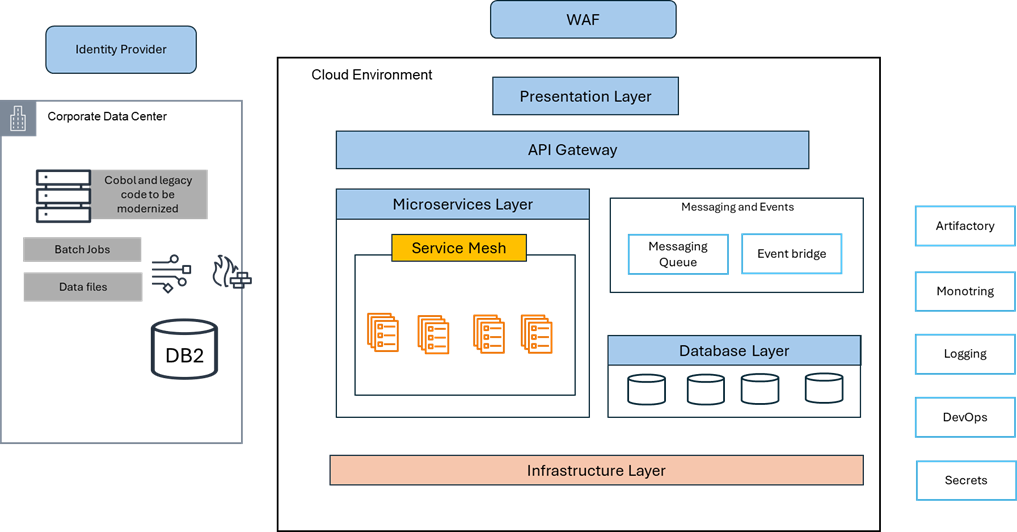
The architecture consists of five layers:
1. Presentation Layer
- Goal: Deliver modern user experiences via web/mobile apps.
- Components:
- API Gateway for routing requests.
- Front-end frameworks (React, Angular, etc.).
- Integration: Communicates with microservices through REST or GraphQL APIs.
2. Microservices Layer
- Goal: Break down monolithic functionality into domain-driven services.
- Design Principles:
- Domain-Driven Design (DDD): Identify bounded contexts.
- Stateless Services: For scalability and resilience.
- Tech Stack: Java/Spring Boot, .NET Core, Node.js, or Go.
3. Data Layer
- Goal: Decouple data from mainframe while ensuring consistency.
- Approach:
- Strangler Pattern: Gradually replace mainframe data access with modern databases.
- Polyglot Persistence: Use relational (PostgreSQL) and NoSQL (MongoDB) as needed.
- Integration: Event-driven architecture for syncing legacy and modern systems.
4. Integration Layer
- Goal: Bridge mainframe and microservices during transition.
- Components:
- API Adapters: Expose mainframe functions as APIs.
- Messaging Systems: Kafka or RabbitMQ for asynchronous communication.
- ETL Pipelines: For data migration and synchronization.
5. Infrastructure Layer
- Goal: Provide scalable, secure, and automated deployment.
- Components:
- Containerization: Docker for packaging services.
- Orchestration: Kubernetes for managing containers.
- CI/CD Pipelines: Jenkins, GitHub Actions, or Azure DevOps.
- Observability: Prometheus, Grafana, and ELK stack for monitoring and logging.
Key Patterns for Migration
- Strangler Fig Pattern: Incrementally replace mainframe components.
- Event-Driven Architecture: Use events for decoupling and real-time updates.
- API Gateway Pattern: Centralized routing and security for microservices.
Security & Compliance
- Implement OAuth2/OpenID Connect for authentication.
- Ensure data encryption in transit and at rest.
- Apply zero-trust principles for service-to-service communication.
Conclusion
Migrating from the mainframe to microservices is a journey, not a one-time project. By adopting a reference architecture, organizations can reduce risk, accelerate modernization, and unlock the benefits of cloud-native systems.